

Vol. 33. Núm. 5.
Páginas 248-255 (Mayo 2026)

Uso adecuado de exploraciones complementarias
Análisis de las pruebas diagnósticas en el punto de atención (POCT): aplicaciones y oportunidades en Atención Primaria

Manuel Gil LópezLucía Ruiz MartínezEva Buller Viqueira
Doi : https://10.1016/j.fmc.2025.11.007
Opciones
Puntos para una lectura rápida

  • •

    Las Point of Care Testing (POCT) son pruebas realizadas en el lugar donde se presta la asistencia, fuera del laboratorio central.

  • •

    Las POCT permiten un control más estrecho de pacientes crónicos desde Atención Primaria.

  • •

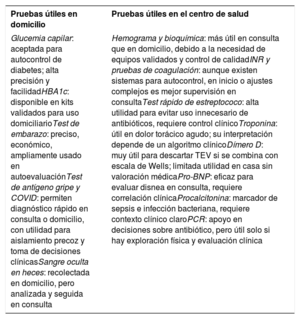
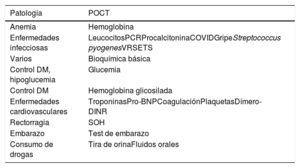
    Ejemplos de POCT: glucemia capilar, coagulación, ProBNP/NT-proBNP, hemoglobina glicada, test rápido de Streptococcus pyogenes (S. pyogenes), test de embarazo, proteína C reactiva (PCR)…

  • •

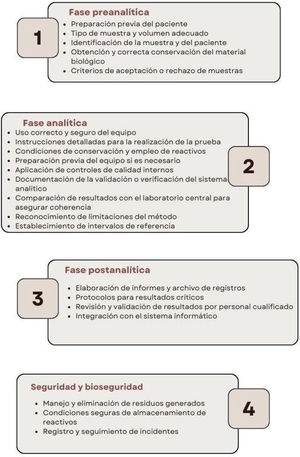
    Fases de las POCT: preanalítica, analítica y postanalítica.

  • •

    La implantación de las POCT en AP mejora la toma de decisiones.

  • •

    La implantación en AP requiere de protocolos claros, control de calidad y formación continuada.

  • •

    La perspectiva de futuro es una mayor integración en la atención sanitaria, permitiendo diagnósticos rápidos junto con una atención más personalizada y eficiente.

Palabras clave
Pruebas en el punto de atención
Atención Primaria de salud
Prueba de diagnóstico rápido
Técnicas de laboratorio clínico
Diagnóstico clínico

Identifíquese

¿Aún no es suscriptor de la revista?
Comprar el acceso al artículo

Comprando el artículo el pdf del mismo podrá ser descargado

Teléfono para incidencias

De lunes a viernes de 9h a 18h (GMT+1) excepto los meses de julio y agosto que será de 9 a 15h
Llamadas desde España 932 415 960
Llamadas desde fuera de España +34 932 415 960
Bibliografía
[1]
P. Oliver Sáez, R. Alonso Díaz, J. Lirón Hernández, V. Monzó Inglés, X. Navarro Segarra, Noval Padillo JÁ, et al.
Guía sobre las pruebas de laboratorio en el lugar de asistencia al paciente (POCT).
Rev Lab Clin., (2016), 9 pp. 60-80
[2]
G. D’Isa, G. Quattrocchi, M.A. López, M. Castro, F. Rodríguez.
Estado actual de las pruebas de laboratorio en el lugar de asistencia del paciente. Rol del bioquímico.
Rev Bioquim., (2024), 89 pp. 71-78
[3]
A. Rodríguez de Cossío, R. Rodríguez Sánchez.
Laboratory tests in primary care (I).
Semergen., (2011), 37 pp. 15-21
[4]
H. Von Schenck, M. Falkensson, B. Lundberg.
Evaluation of “HemoCue” a new device for determining hemoglobin.
Clin Chem., (1986), 32 pp. 526-529
[5]
M.L. Giménez, A. Peña.
Evolución de las pruebas de laboratorio en el lugar de asistencia al paciente (POCT).
Soc Esp Med Lab., (2018), pp. 64-73
[6]
American Diabetes Association.
Improving care and promoting health in populations: Standards of care in diabetes 2024.
Diabetes Care., (2024), 47 pp. S11-S19
[7]
International Organization for Standardization.
ISO 15197:2013. In vitro diagnostic test systems – Requirements for blood-glucose monitoring systems forself-testing in managing diabetes mellitus.
ISO, (2013),
[8]
E. Castro-Portillo, R. López-Izquierdo, A. Sanz-García, G.J. Ortega, J.F. Delgado-Benito, M.A. Castro Villamor, et al.
Role of prehospital point-of-care N-terminal pro-brain natriuretic peptide in acute life-threatening cardiovascular disease.
Int J Cardiol., (2022), 364 pp. 126-132
[9]
C.J. Taylor, J.M. Ordóñez-Mena, S.L. Lay-Flurrie, C.R. Goyder, K.S. Taylor, N.R. Jones, et al.
Natriuretic peptide testing and heart failure diagnosis in primary care: diagnostic accuracy study.
Br J Gen Pract., (2023), 73 pp. e1-e8
[10]
J.F. Cohen, N. Bertille, R. Cohen, M. Chalumeau.
Rapid antigen detection test for group A streptococcus in children with pharyngitis.
Cochrane Database Syst Rev., (2016), 7 pp. CD010502
[11]
R. Piñeiro Pérez, F. Hijano Bandera, F. Álvez González, A. Fernández Landaluce, J.C. Silva Rico, C. Pérez Cánovas, et al.
Documento de consenso sobre el diagnóstico y tratamiento de la faringoamigdalitis aguda.
An Pediatr (Engl Ed)., (2011), 75 pp. e1-e12
[12]
TecSalud. Pruebas de embarazo. Tipos de pruebas, cuándo hacerlas, dónde realizarlas [Internet]. Blog TecSalud; 2020 [citado 19 sep 2025]. Disponible en: https://blog.tecsalud.mx/portal-de-papas/pruebas-de-embarazo.
[13]
M. Kankaanpää, M. Raitakari, L. Muukkonen, S. Gustafsson, M. Heitto, A. Palomäki, et al.
Point-of-care pregnancy testing provides staff satisfaction but does not reduce length of stay in the emergency department.
Scand J Trauma Resusc Emerg Med., (2016), 24 pp. 125
[14]
H. So, K. Kwon, J. Park, K. Kim.
Comparison of four point-of-care devices for pregnancy test in urine.
J LabMedQualAssur., (2023), 45 pp. 120-124
[15]
K. Kaur, M. Zubair, J.J. Adamski.
Fecal occultblood test [Internet].
In: Stat Pearls, Stat Pearls Publishing, (2025 Jan),
[16]
T.M. Zarchy, M.L. Erbland, D.J. Rosenberg, N. Feldman.
Debunking the fecal occult blood test: results of a national survey.
Am J Gastroenterol., (2017), 112 pp. S342-S343
[17]
T.R. Levin, P.G. Hess, J.H. Bond, D. Johnson, D.G. Weiss, R.E. Schoen, et al.
Screening for colorectal cancer with fecal immunochemical tests: a systematic review.
Am J Gastroenterol., (2011), 106 pp. 2130-2145
[18]
M.B. Pepys, G.M. Hirschfield.
C-reactive protein: a critical update.
J Clin Invest., (2003), 111 pp. 1805-1812
[19]
C. Llor, A. Plate, L. Bjerrum, I. Gentile, H. Melbye, A. Staiano, et al.
C-reactive protein point-of-care testing in primary care— broader implementation needed to combat antimicrobial resistance.
Front Public Health., (2024), 12
[20]
O. Van Hecke, L. Bjerrum, I. Gentile, R. Hopstaken, H. Melbye, A. Plate, et al.
Guidance on C-reactive protein point-of-care testing and complementary strategies to improve antibiotic prescribing for adults with lower respiratory tract infections in primary care.
[21]
M. Auron, G.B. Seymann.
Utility of procalcitonin in clinical practice.
Brown Hosp Med., (2023), 2
[22]
M.C. Larkins, A. Thombare.
Pruebas en el punto de atención [Internet].
In: StatPearls, Stat Pearls Publishing, (2025 Jan),
[23]
P. Pellegrini Pinto, C. Cárdenas Soto, V. Ramírez Muñoz, H. Moscoso Espinoza, C. Camargo Grandón, C. Lobos, et al.
Tamizaje de drogas de abuso en orina en el laboratorio clinico. Versión 2.
Instituto de Salud Pública de Chile, (2024),
[24]
J.N. Scherer, J.B. Schuch, F.D. Rabelo-da-Ponte, R. Silvestrin, R. Ornell, T. Sousa, et al.
Analytical reliability of four oral fluid point-of-collection testing devices for drug detection in drivers.
Forensic Sci Int., (2020), 315 pp. 110434
[25]
C.C. Almonacid Urrego, M.V. Giratá Pedraza, I. Salcedo Pretelt, I.C. Almonacid Urrego.
Papel de las pruebas rápidas (POCT) en el diagnóstico del SARS-COV-2, agente causal de COVID-19.
Nova., (2020), 18 pp. 43-52
[26]
T.K. Teoh, J. Powell, J. Kelly, C. McDonnell, R. Whelan, N.H. O’Connell, et al.
Outcomes of point-of-care testing for influenza in the emergency department of a tertiary referral hospital in Ireland.
J Hospital Infection., (2021), 110 pp. 45-51
[27]
Echávarri Olavarría F, Molina Amores C. VRS. Pruebas para la detección rápida (7/2022). En Guía-ABE. Infecciones en Pediatría. Guía rápida para la selección del tratamiento antimicrobiano empírico [en línea]. [consultado 1 Oct 2025]. Disponible en http://www.guia-abe.es [en línea].
[28]
C. Gutiérrez Alonso, E. Buller Viqueira, D. Ortega Moreno.
Toma de muestras en diversas localizaciones ante la sospecha de una enfermedad de transmisión sexual en Atención Primaria.
FMC., (2022), 29 pp. 249-251
[29]
J.W.L. Cals, C.C. Butler, R.M. Hopstaken, K. Hood, G.J. Dinant.
Effect of point-of-care testing for C-reactive protein and training in communication skills on antibiotic use in lower respiratory tract infections: cluster randomised trial.
BMJ., (2009), 338 pp. b1374
[30]
N.A. Martínez-González, E. Keizer, A. Plate, S. Coenen, F. Valeri, J.Y.J. Verbakel, et al.
Point-of-care C-reactive protein testing to reduce antibiotic prescribing for acute respiratory tract infections in primary care: systematic review and meta-analysis of randomized controlled trials.
Antibiotics (Basel)., (2020), 9 pp. 610
[31]
G. Gidske, S. Sandberg, A.L. Fossum, S. Binder, E.C. Langsjøen, A.E. Solsvik, et al.
Point-of-care testing in primary healthcare: a scoring system to determine the frequency of performing internal quality control.
Clin Chem Lab Med., (2022), 60 pp. 740-747
[32]
P.F. Van Rheenen, E. Van de Vijver, V. Fidler.
Faecal calprotect in for screening of patients with suspected inflammatory bowel disease: diagnostic meta-analysis.
BMJ., (2010), 341 pp. c3369
[33]
Junta de Andalucía.
Consejería de Salud y Consumo. Proyecto de incorporación de pruebas rápidas en Atención Primaria.
Junta de Andalucía, (2022),
[34]
C. Llor, M. Alkorta Gurrutxaga, J. de la Flor i Bru, S. Bernárdez Carracedo, J.L. Cañada Merino, M. Bárcena Caamaño, et al.
Recomendaciones de utilización de técnicas de diagnóstico rápido en infecciones respiratorias en atención primaria.
Aten Primaria., (2017), 49 pp. 426-437
[35]
O. Schnell, J.B. Crocker, J. Weng.
Impact of HbA1c Testing at Point of Care on Diabetes Management.
J Diabetes Sci Technol., (2017), 11 pp. 611-617
[36]
Sociedad Española de Medicina de Laboratorio. Pruebas de laboratorio en el lugar de asistencia (POCT) [Internet]. 2020 Mar 16 [citado 19 Sep 2025]. Disponible en: https://www.labtestsonline.es/articles/articles-pruebas-de-laboratorio-en-el-lugar-de-asistencia-poct.
[37]
A.I. Khan.
Best laboratory practices regarding POCT in different settings (hospital and outside the hospital).
EJIFCC., (2021), 32 pp. 124-130
[38]
International Federation of Biomedical Laboratory Science (IFBLS). IFBLS’ guidelines– Point of care testing (POCT) [Internet]. Ontario (Canada): IFBLS; 2010 [citado 19 Sep 2025]. Disponible en: https://www.ifbls.org/images/IFBLS_Documents/POCT.PDF.