

Vol. 33. Núm. 5.
Páginas 239-247 (Mayo 2026)

Actualizando la práctica asistencial
Rosácea

Adolfo Alejandro Cabanillas CabralLía Bejarano AntonioMaría del Carmen Fraile Alonso
Doi : https://10.1016/j.fmc.2025.11.006
Opciones
Puntos para una lectura rápida

  • •

    Es necesario tener en cuenta que los pacientes con rosácea son más susceptibles a algunas enfermedades como diabetes mellitus, celiaquía, esclerosis múltiple o artritis reumatoide. Se recomienda tener esto en cuenta durante la entrevista clínica, especialmente en mujeres de mediana edad, y realizar despistaje adecuado en los pacientes seleccionados.

  • •

    La fisiopatología de la rosácea engloba factores exógenos, genéticos, vasculares e inmunitarios.

  • •

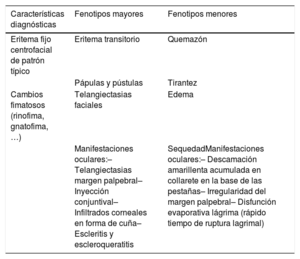
    La nueva clasificación establecida en 2017 propone el enfoque diagnóstico por fenotipos en lugar de por subtipos cerrados como se realizaba de forma tradicional.

  • •

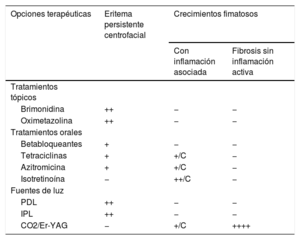
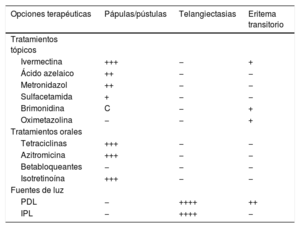
    El tratamiento de la rosácea debe enfocarse en función del fenotipo concreto de cada paciente y los mecanismos fisiopatogénicos subyacentes, sin olvidar la prevención de los factores desencadenantes, especialmente la fotoprotección.

  • •

    La isotretinoína oral a dosis bajas es efectiva en el manejo de todos los fenotipos de rosácea, excepto la ocular, en la que es más efectiva la antibioterapia oral. Deben mantenerse los controles analíticos y de prevención del embarazo indicados durante la toma de isotretinoína oral.

  • •

    Las fuentes de luz (láser o luz pulsada) representan un aspecto fundamental en el tratamiento de todos los fenotipos en rosácea.

Palabras clave
Rosácea
Tratamiento tópico
Tratamiento oral
Fuentes de luz
Situaciones especiales

Identifíquese

¿Aún no es suscriptor de la revista?
Comprar el acceso al artículo

Comprando el artículo el pdf del mismo podrá ser descargado

Teléfono para incidencias

De lunes a viernes de 9h a 18h (GMT+1) excepto los meses de julio y agosto que será de 9 a 15h
Llamadas desde España 932 415 960
Llamadas desde fuera de España +34 932 415 960
Bibliografía
[1]
E.J. Van Zuuren.
Rosacea.
N Engl J Med, (2017), 377 pp. 1754-1764
[2]
J. Tan, M. Berg.
Rosacea: current state of epidemiology.
J Am Acad Dermatol., (2013), 69 pp. S27-S35
[3]
E. Alia, H. Feng.
Rosacea pathogenesis, common triggers, and dietary role: The cause, the trigger, and the positive effects of different foods.
Clin Dermatol., (2022), 40 pp. 122-127
[4]
R.L. Gallo, R.D. Granstein, S. Kang, M. Mannis, M. Steinhoff, J. Tan, et al.
Standard classification and pathophysiology of rosacea: The 2017 update by the National Rosacea Society Expert Committee.
J Am Acad Dermatol., (2018), 78 pp. 148-155
[5]
C.W. Chiu, J. Tsai, Y.C. Huang.
Health-related Quality of Life of Patients with Rosacea: A Systematic Review and Meta-analysis of Real-world Data.
Acta Derm Venereol., (2024), 104 pp. adv40053
[6]
K. Nicholson, L. Abramova, M.M. Chren, J. Yeung, S.Y. Chon, S.C. Chen.
A pilot quality-of-life instrument for acne rosacea.
J Am Acad Dermatol., (2007), 57 pp. 213-221
[7]
M. Salleras Redonnet, J. Del Pozo Losada, M. Ribera Pibernat.
[Translated article] Cross-Cultural Validation of the RosaQoL Scale in Spanish Language.
Actas Dermosifiliogr., (2024), 115 pp. T858-T866
[8]
D. Thiboutot, R. Anderson, F. Cook-Bolden, Z. Draelos, R.L. Gallo, R.D. Granstein, et al.
Standard management options for rosacea: The 2019 update by the National Rosacea Society Expert Committee.
J Am Acad Dermatol., (2020), 82 pp. 1501-1510
[9]
R.L. Gallo, R.D. Granstein, S. Kang, M. Mannis, M. Steinhoff, J. Tan, et al.
Rosacea comorbidities and future research: The 2017 update by the National Rosacea Society Expert Committee.
J Am Acad Dermatol., (2018), 78 pp. 167-170
[10]
A. Friedman.
JAAD Game Changers: Clustering of autoimmune diseases in patients with rosacea.
J Am Acad Dermatol., (2025), 92 pp. 67
[11]
A. Egeberg, P.R. Hansen, G.H. Gislason, J.P. Thyssen.
Clustering of autoimmune diseases in patients with rosacea.
J Am Acad Dermatol., (2016), 74
[12]
J. Von Stebut, M. Mallach, S. Schneider-Burrus, M. Heiland, C. Rendenbach, R. Preissner, et al.
Rosacea is strongly associated with melanoma in Caucasians.
Sci Rep., (2024), 14 pp. 11949
[13]
P. Abdi, Z. Haq, M.J. Diaz, H.I. Maibach, B. Ogunyemi.
Rosacea as a potential risk factor for dementia.
Int J Dermatol., (2024), 63 pp. e200-e202
[14]
Y. Gao, X.J. Yang, Y. Zhu, M. Yang, F. Gu.
Association between rosacea and helicobacter pylori infection: A meta-analysis.
PLoS One., (2024), 19 pp. e0301703
[15]
B.M. Rainer, A.H. Fischer, D. Luz Felipe da Silva, S. Kang, A.L. Chien.
Rosacea is associated with chronic systemic diseases in a skin severity-dependent manner: results of a case-control study.
J Am Acad Dermatol., (2015), 73 pp. 604-608
[16]
R.S.Q. Geng, A.N. Bourkas, A. Mufti, R.G. Sibbald.
Rosacea: Pathogenesis and Therapeutic Correlates.
J Cutan Med Surg., (2024), 28 pp. 178-189
[17]
M. Cui, P. Honore, C. Zhong, D. Gauvin, J. Mikusa, G. Hernandez, et al.
TRPV1 receptors in the CNS play a key role in broad-spectrum analgesia of TRPV1 antagonists.
J Neurosci., (2006), 26 pp. 9385-9393
[18]
R.L. Baylie, J.E. Brayden.
TRPV channels and vascular function.
Acta Physiol (Oxf)., (2011), 203 pp. 99-116
[19]
K.Y. Tu, C.J. Jung, Y.H. Shih, A.L.S. Chang.
Therapeutic strategies focusing on immune dysregulation and neuroinflammation in rosacea.
Front Immunol., (2024), 15 pp. 1403798
[20]
K. Yamasaki, R.L. Gallo.
The molecular pathology of rosacea.
J Dermatol Sci., (2009), 55 pp. 77-81
[21]
F.M.N. Forton.
The Pathogenic Role of Demodex Mites in Rosacea: A Potential Therapeutic Target Already in Erythematotelangiectatic Rosacea?.
Dermatol Ther (Heidelb)., (2020), 10 pp. 1229-1253
[22]
N. Lacey, A. Russell-Hallinan, C.C. Zouboulis, F.C. Powell.
Demodex mites modulate sebocyte immune reaction: possible role in the pathogenesis of rosacea.
Br J Dermatol., (2018), 179 pp. 420-430
[23]
Q. Chen, M. Jin, F. Yang, J. Zhu, Q. Xiao, L. Zhang.
Matrix metalloproteinases: inflammatory regulators of cell behaviors in vascular formation and remodeling.
Mediators Inflamm., (2013), 2013 pp. 928315
[24]
L. Gether, L.K. Overgaard, A. Egeberg, J.P. Thyssen.
Incidence and prevalence of rosacea: a systematic review and meta-analysis.
Br J Dermatol., (2018), 179 pp. 282-289
[25]
M. Schaller, L.M.C. Almeida, A. Bewley, B. Cribier, J. Del Rosso, N.C. Dlova, et al.
Recommendations for rosacea diagnosis, classification and management: update from the global ROSacea COnsensus 2019 panel.
Br J Dermatol., (2020), 182 pp. 1269-1276
[26]
J. Tan, L.M. Almeida, A. Bewley, B. Cribier, N.C. Dlova, R. Gallo, et al.
Updating the diagnosis, classification and assessment of rosacea: recommendations from the global ROSacea COnsensus (ROSCO) panel.
Br J Dermatol., (2017), 176 pp. 431-438
[27]
J. Liang, Y. Chen, Z. Wang, Y. Wang, S. Mu, D. Zhang, et al.
Exploring the association between rosacea and acne by integrated bioinformatics analysis.
[28]
S.P. Parraga, S.R. Feldman.
Biomarkers for rosacea?.
J Eur Acad Dermatol Venereol., (2024), 38 pp. 993-994
[29]
S. Liang, Y. Fang, Z. Zhao, B. Wang, Y. Huang, H. Xie, et al.
Hematological parameters as diagnostic biomarkers for patients with rosacea.
J Dermatol. Jun, (2024), 51 pp. 791-798
[30]
S. Tavassoli, N. Wong, E. Chan.
Ocular manifestations of rosacea: A clinical review.
Clin Exp Ophthalmol., (2021), 49 pp. 104-117
[31]
C. Cole, T. Shyr, H. Ou-Yang.
Metal oxide sunscreens protect skin by absorption, not by reflection or scattering.
Photodermatol Photoimmunol Photomed., (2016), 32 pp. 5-10
[32]
J.Q. Del Rosso, S. Bruce, M. Jarratt, A. Menter, G. Staedtler.
Efficacy of topical azelaic acid (AzA) gel 15% plus oral doxycycline 40mg versus metronidazole gel 1% plus oral doxycycline 40mg in mild-to-moderate papulopustular rosacea.
J Drugs Dermatol., (2010), 9 pp. 607-613
[33]
D.M. Thiboutot, A.B. Fleischer, J.Q. Del Rosso, K. Graupe.
Azelaic acid 15% gel once daily versus twice daily in papulopustular rosacea.
J Drugs Dermatol., (2008), 7 pp. 541-546
[34]
S. King, J. Campbell, R. Rowe, M.L. Daly, G. Moncrieff, C. Maybury.
A systematic review to evaluate the efficacy of azelaic acid in the management of acne, rosacea, melasma and skin aging.
J Cosmet Dermatol., (2023), 22 pp. 2650-2662
[35]
A. Sharma, G. Kroumpouzos, M. Kassir, H. Galadari, A. Goren, S. Grabbe, et al.
Rosacea management: A comprehensive review.
J Cosmet Dermatol., (2022), 21 pp. 1895-1904
[36]
T. Nakatsuji, J.Y. Cheng, A. Butcher, F. Shafiq, O. Osuoji, R.L. Gallo, et al.
Topical Ivermectin Treatment of Rosacea Changes the Bacterial Microbiome of the Skin.
[37]
A. Taieb, A. Khemis, T. Ruzicka, W. Baránska-Rybak, J. Berth-Jones, J. Schauber, et al.
Maintenance of remission following successful treatment of papulopustular rosacea with ivermectin 1% cream vs. metronidazole 0.75% cream: 36-week extension of the ATTRACT randomized study.
J Eur Acad Dermatol Venereol., (2016), 30 pp. 829-836
[38]
M.G. Ivanic, A. Oulee, A. Norden, S.S. Javadi, M.H. Gold, J.J. Wu.
Neurogenic Rosacea Treatment: A Literature Review.
J Drugs Dermatol., (2023), 22 pp. 566-575
[39]
D.I. Jesudason, N. Appalanaidu, A. Khan.
Symptomatic bradycardia associated with topical brimonidine gel (Mirvaso) administration: a case report.
Eur Heart J Case Rep., (2024), 8 pp. ytae329
[40]
F. Liu, Q. Zhou, H. Wang Fu, Y. Li, M. Tao, et al.
Efficacy and safety of oxymetazoline for the treatment of rosacea: A meta-analysis.
J Cosmet Dermatol. Sep, (2023), 22 pp. 2408-2419
[41]
J.Q. Del Rosso.
Evaluating the role of topical therapies in the management of rosacea: focus on combination sodium sulfacetamide and sulfur formulations.
Cutis., (2004), 73 pp. 29-33
[42]
H. Zhang, L. Yang, Y. Wang, D. Zhang, K. Tang, R. Fang, et al.
Topical calcineurin inhibitors as a double-edged sword in rosacea: A systematic review.
J Cosmet Dermatol., (2022), 21 pp. 1695-1704
[43]
L.S. Gold, J.Q. Del Rosso, L. Kircik, N.D. Bhatia, D. Hooper, W.K. Nahm, et al.
Minocycline 1.5% foam for the topical treatment of moderate to severe papulopustular rosacea: Results of 2 phase 3, randomized, clinical trials.
J Am Acad Dermatol., (2020), 82 pp. 1166-1173
[44]
J.F. Conde, C.B. Yelverton, R. Balkrishnan, A.B. Fleischer, S.R. Feldman.
Managing rosacea: a review of the use of metronidazole alone and in combination with oral antibiotics.
J Drugs Dermatol., (2007), 6 pp. 495-498
[45]
M.M.D. Van der Linden, A.R. van Ratingen, D.C. van Rappard, S.A. Nieuwenburg, P.I. Spuls.
DOMINO, doxycycline 40 mg vs. minocycline 100 mg in the treatment of rosacea: a randomized, single-blinded, noninferiority trial, comparing efficacy and safety.
Br J Dermatol., (2017), 176 pp. 1465-1474
[46]
J.Q. Del Rosso, S. Brantman, H. Baldwin.
Long-term inflammatory rosacea management with subantibiotic dose oral doxycycline 40mg modified-release capsules once daily.
Dermatol Ther., (2022), 35 pp. e15180
[47]
M. Lova Navarro, P. Sánchez-Pedreño Guillen, A.M. Victoria Martínez, T. Martínez Menchón, R. Corbalán Vélez, J. Frías Iniesta.
Papulopustular Rosacea: Response to Treatment with Oral Azithromycin.
Actas Dermosifiliogr (Engl Ed)., (2018), 109 pp. 529-535
[48]
O. Bakar, Z. Demirçay, O. Gürbüz.
Therapeutic potential of azithromycin in rosacea.
Int J Dermatol., (2004), 43 pp. 151-154
[49]
A. Assiri, A.H. Hobani, H.A. AlKaabi, M.E. Mojiri, S.A. Daghriri, O.A. Suwaid, et al.
Efficacy of Low-Dose Isotretinoin in the Treatment of Rosacea: A Systematic Review and Meta-Analysis.
Cureus., (Mar 2024), 16 pp. e57085
[50]
A. King, M.G. Tan, C. Kirshen, S.N. Tolkachjov.
Low-dose isotretinoin for the management of rosacea: A systematic review and meta-analysis.
J Eur Acad Dermatol Venereol., (2024),
[51]
S. Desai, A. Friedman.
Isotretinoin for rosacea: A systematic review.
JAAD Int., (2024), 16 pp. 112-118
[52]
T. Zhang, X. Liu, L. Zhang, X. Jiang.
Treatment of rosacea with upadacitinib and abrocitinib: case report and review of evidence for Janus kinase inhibition in rosacea.
Front Immunol., (2024), 15 pp. 1416004
[53]
J.G.M. Logger, J.I. Olydam, R.J.B. Driessen.
Use of beta-blockers for rosacea-associated facial erythema and flushing: A systematic review and update on proposed mode of action.
J Am Acad Dermatol., (2020), 83 pp. 1088-1097
[54]
J. Zdrada-Nowak, A. Stolecka-Warzecha, W. Odrzywołek, A. Deda, B. Błńska-Fajfrowska, S. Wilczyński.
Hyperspectral assessment of acne skin exposed to intense pulsed light (IPL) intense pulsed light in acne treatment.
Skin Res Technol., (2023), 29 pp. e13338
[55]
H. Husein-ElAhmed, M. Steinhoff.
Light-based therapies in the management of rosacea: a systematic review with meta-analysis.
Int J Dermatol., (2022), 61 pp. 216-225
[56]
Q. Zhai, S. Cheng, R. Liu, J. Xie, X. Han, Z. Yu.
Meta-Analysis of the Efficacy of Intense Pulsed Light and Pulsed-Dye Laser Therapy in the Management of Rosacea.
J Cosmet Dermatol., (2024), 23 pp. 3821-3827
[57]
L. Nguyen, C. Dierckxsens, M. Kerscher, A. Hartjen, S.W. Schneider, K. Herberger.
Rosacea treatment with 532nm KTP versus 595nm pulsed dye laser-A prospective, controlled study.
J Cosmet Dermatol., (2024), 23 pp. 2443-2449
[58]
A. Chen, J. Choi, E. Balazic, T.R. Zhu, K. Kobets.
Review of laser and energy-based devices to treat rosacea in skin of color.
J Cosmet Laser Ther., (2024), 26 pp. 43-53
[59]
V. Madan, J.E. Ferguson, P.J. August.
Carbon dioxide laser treatment of rhinophyma: a review of 124 patients.
Br J Dermatol., (2009), 161 pp. 814-818
[60]
A. Orenstein, J. Haik, J. Tamir, E. Winkler, J. Frand, I. Zilinsky, et al.
Treatment of rhinophyma with Er:YAG laser.
Lasers Surg Med., (2001), 29 pp. 230-235
[61]
P. Kamrani, M. Boen, S.G. Fabi, M.P. Goldman.
From CO2 to Er:YAG: A Comprehensive Review of Laser Treatments for Rhinophyma.
J Drugs Dermatol., (2024), 23 pp. 932-936
[62]
K.H. Takahashi, T.O. Utiyama, E. Bagatin, F.R. Picosse, F.A. Almeida.
Efficacy and safety of botulinum toxin for rosacea with positive impact on quality of life and self-esteem.
Int J Dermatol., (2024), 63 pp. 590-596
[63]
C.G. Ardila, L.A. Colorado Franco, M. Franco, A. Galeano, A.J.H. Molina, J.R. Amador, et al.
A Case Series of a Novel Approach in the Treatment of Rosacea: Use of Botulinum Toxin and Intense Pulsed Light for the Treatment of Erythematotelangiectatic Rosacea.
J Cosmet Dermatol., (2025), 24 pp. e16774
[64]
B.B. Daǧtas¸, O. Erdem, T. Güneç, E.B. Avcı, V. Manav, A.E. Koku Aksu.
Effects of Botulinum Toxin Type A Treatment on Clinical and Biophysical Parameters in Patients With Erythematotelangiectatic Rosacea: A Prospective, Randomized, Controlled, Double-Blind Study.
[65]
L. Calvisi, A. Diaspro, G. Sito.
Microbotox: A prospective evaluation of dermatological improvement in patients with mild-to-moderate acne and erythematotelangiectatic rosacea.
J Cosmet Dermatol., (2022), 21 pp. 3747-3753
[66]
J. Zhang, D. Gu, Y. Yan, R. Pan, H. Zhong, C. Zhang, et al.
Potential Role of Tranexamic Acid in Rosacea Treatment: conquering Flushing Beyond Melasma.
Clin Cosmet Investig Dermatol., (2024), 17 pp. 1405-1412
[67]
N.K.F. Wienholtz, C.E. Christensen, T.P. Do, L.E.W. Frifelt, J. Snellman, C.L. Lopez-Lopez, et al.
Erenumab for Treatment of Persistent Erythema and Flushing in Rosacea: A Nonrandomized Controlled Trial.
JAMA Dermatol, (2024), 160 pp. 612-619
[68]
S. Avraham, S. Khaslavsky, N. Kashetsky, S.Y. Starkey, K. Zaslavsky, J.M. Lam, et al.
Treatment of ocular rosacea: a systematic review.
J Dtsch Dermatol Ges., (2024), 22 pp. 167-174
[69]
T. Gomolin, A. Cline, F. Pereira.
Treatment of rosacea during pregnancy.
Dermatol Online J., (2021), 27
[70]
E.C. Wilkerson, M.M. Van Acker, B.S. Bloom, D.J. Goldberg.
Utilization of Laser Therapy During Pregnancy: A Systematic Review of the Maternal and Fetal Effects Reported From 1960 to 2017.
Dermatol Surg., (2019), 45 pp. 818-828
[71]
Y.R. Woo, H.S. Kim.
Deciphering Childhood Rosacea: A Comprehensive Review.
[72]
L. Noguera-Morel, A. Hernández-Martín, A. Torrelo.
Childhood rosacea and related disorders.
Clin Exp Dermatol., (2021), 46 pp. 430-437