

Vol. 31. Núm. 6.
Páginas 32-42 (Junio 2024)

Capítulo 4
Claves para uso racional de opioides en el tratamiento del dolor persistente

Luz de Myotanh Vázquez CanalesabcdAnna Dalmau-RoigefAmadeu Obachg
Doi : https://10.1016/j.fmc.2024.05.005
Opciones
Puntos para una lectura rápida

  • •

    La utilización de opioides en personas afectadas por dolor persistente no oncológico no está demostrada más allá de las 12 semanas.

  • •

    Es necesario hacer una evaluación antes de la prescripción de opioides para ponderar el riesgo de la persona afectada y el balance riesgo-beneficio.

  • •

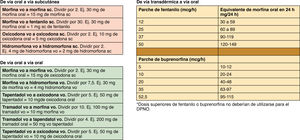
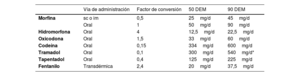
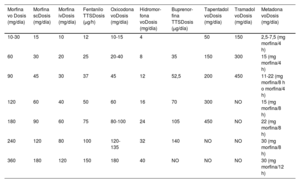
    Las tablas de equianalgesia permiten hacer una rotación de opioides aproximada pero debido a las diferencias interindividuales es complejo tener la dosis exacta del opioide al que se rota.

  • •

    Conocer la farmacología de los opioides permite evitar errores en su prescripción, así como en su rotación.

  • •

    Antes de iniciar el tratamiento con opioides, se recomienda realizar un pacto terapéutico con la persona afectada que incluya toda la información necesaria, los objetivos y el plan de tratamiento.

  • •

    El tratamiento debe iniciarse a la mínima dosis posible y durante un tiempo limitado, solo si los beneficios observados superan los potenciales riesgos.

  • •

    El seguimiento debe realizarse como máximo a las 4 semanas después de iniciar el tratamiento de prueba y posteriormente cada 3 meses.

  • •

    La deprescripción está indicada en todas las personas afectadas por dolor persistente no oncológico en tratamiento crónico con opioides, particularmente en aquellas en que los riesgos superen los beneficios, incumplan el pacto terapéutico, lo soliciten o se resuelva el cuadro doloroso.

  • •

    Se recomienda que la deprescripción sea consensuada con la persona afectada, utilizando los principios de la entrevista motivacional siempre que sea posible.

Palabras clave
Atención primaria
Medicina de familia
Analgésicos opioides
Deprescripción
Farmacología

Identifíquese

¿Aún no es suscriptor de la revista?
Comprar el acceso al artículo

Comprando el artículo el pdf del mismo podrá ser descargado

Teléfono para incidencias

De lunes a viernes de 9h a 18h (GMT+1) excepto los meses de julio y agosto que será de 9 a 15h
Llamadas desde España 932 415 960
Llamadas desde fuera de España +34 932 415 960
Bibliografía
[1]
A. Henche, J.M. Paredero.
Claves para un uso adecuado de opioides en dolor crónico no oncológico [Internet].
Boletín de Información Farmacoterapéutica de Navarra., (2019),
[2]
R. Chou, J.A. Turner, E.B. Devine, R.N. Hansen, S.D. Sullivan, I. Blazina, et al.
The effectiveness and risks of long-term opioid therapy for chronic pain: a systematic review for a National Institutes of Health Pathways to Prevention Workshop.
Ann Intern Med., (2015), 162 pp. 276-286
[3]
A. Perelló, L. Vázquez, M. de.
Opioides: cómo usarlos en el dolor persistente sin morir en el intento.
Actualización en Medicina de Familia (AMF)., (2023), 19 pp. 94-100
[4]
N. Volkow, H. Benveniste, A.T. McLellan.
Use and misuse of opioids in chronic pain.
Annu Rev Med., (2018), 69 pp. 451-465
[5]
J. Guardia, A. Henche, A. Legoña, J.A. Álvarez, S. Calvete, R.M. Fernández-Marcote, et al.
Guía de consenso para el buen uso de analgésicos opioides [Internet].
Valencia, (2017),
[6]
N.R. Brott, E. Peterson, M. Cascella.
Opioid, risk tool.
StatPearls [Internet], (2022),
[7]
Saila O, de Salud D. Dolor crónico no oncológico: ¿opioides? Información Farmakoterapia Informazioa INFAC [Internet]. 2022; 30:1-10 [citado 28 Oct 2023]. Disponible en: https://www.euskadi.eus/contenidos/informacion/cevime_infac_2022/es_def/adjuntos/INFAC_Vol_30_1_OPIOIDES-DCNO.pdf.
[8]
D. Dowell, T.M. Haegerich, R. Chou.
CDC Guideline for Prescribing Opioids for Chronic Pain - United States, 2016.
MMWR Recomm Rep., (2016), 65 pp. 1-49
[9]
D. Dowell, K.R. Ragan, C.M. Jones, G.T. Baldwin, R. Chou.
CDC Clinical Practice Guideline for Prescribing Opioids for Pain — United States, 2022.
MMWR Recomm Rep., (2022), 71 pp. 1-95
[10]
P.E. Shaheen, D. Walsh, W. Lasheen, M.P. Davis, R.L. Lagman.
Opioid equianalgesic tables: Are they all equally dangerous?.
J Pain Symptom Manage., (2009), 38 pp. 409-417
[11]
HSC Northern Ireland guidelines on converting doses of opioid analgesics for adult use [Internet]. 2018 [citado 3 Sep 2023]. Disponible en: https://gpni.co.uk/clinical_resources/northern-ireland-guidelines-on-converting-doses-of-opioid-analgesics-for-adult-use/.
[12]
Axencia de Coñecimientos en Saúde. Servizio Galego de Sáude. Rotación opioides [Internet]. A Coruña; 2020 [citado 3 Sep 2023]. Disponible en: https://www.sergas.es/Asistencia-sanitaria/Documents/1414/3.4 _Rotacion_de_opioides.pdf.
[13]
L. Manchikanti, A.M. Kaye, N.N. Knezevic, H. McAnally, K. Slavin, A.M. Trescot, et al.
Responsible, safe, and effective prescription of opioids for chronic non-cancer pain: American Society of Interventional Pain Physicians (ASIPP) Guidelines.
Pain Physician., (2017), 20 pp. S3-S92
[14]
Henche AI. El auge de la analgesia opioide. Problemas relacionados con su uso a largo plazo [Internet]. Boletín Farmacoterapéutico de Castilla-La Mancha. 2016; 17 [citado 30 Sep 2023]. Disponible en: https://sanidad.castillalamancha.es/sites/sescam.castillalamancha.es/files/documentos/farmacia/boletin_3_2016.pdf.
[15]
K. Kroenke, D.P. Alford, C. Argoff, B. Canlas, E. Covington, J.W. Frank, et al.
Challenges with implementing the Centers for Disease Control and Prevention Opioid Guideline: A consensus panel report.
Pain Med., (2019), 20 pp. 724-735
[16]
C. Berna, R.J. Kulich, J.P. Rathmell.
Tapering long-term opioid therapy in chronic noncancer pain.
Mayo Clin Proc., (2015), 90 pp. 828-842
[17]
B.D. Darnall, M.S. Ziadni, R.L. Stieg, I.G. Mackey, M.C. Kao, P. Flood.
Patient-centered prescription opioid tapering in community outpatients with chronic pain.
JAMA Intern Med, (2018), 178 pp. 707-708
[18]
US Department of Health and Human Services Working Group on Patient-Centered Reduction or Discontinuation of Long-term Opioid Analgesics.
HHS guide for clinicians on the appropriate dosage reduction or discontinuation of long-term opioid analgesics [Internet]. U. S. Department of Health and Human Services.
US Department of Health and Human Services, (2019),
[19]
R. Chou, G.J. Fanciullo, P.G. Fine, J.A. Adler, J.C. Ballantyne, P. Davies, et al.
Clinical guidelines for the use of chronic opioid therapy in chronic noncancer pain.
J Pain., (2009), 10 pp. 113-130
[20]
S.M. Thielke, J.A. Turner, S.M. Shortreed, K. Saunders, L. LeResche, C.I. Campbell, et al.
Do patient-perceived pros and cons of opioids predict sustained higher-dose use?.
Clin J Pain., (2014), 30 pp. 93-101
[21]
A.S. Bohnert, M. Valenstein, M.J. Bair, D. Ganoczy, J.F. McCarthy, M.A. Ilgen, et al.
Association between opioid prescribing patterns and opioid overdose-related deaths.
JAMA., (2011), 305 pp. 1315-1321
[22]
A.S. Bohnert, J.E. Logan, D. Ganoczy, D. Dowell.
A detailed exploration into the association of prescribed opioid dosage and overdose deaths among patients with chronic pain.
Med Care., (2016), 54 pp. 435-441
[23]
J.W. Busse, S. Craigie, D.N. Juurlink, D.N. Buckley, L. Wang, R.J. Couban, et al.
Guideline for opioid therapy and chronic noncancer pain.
CMAJ., (2017), 189 pp. E659-E666
[24]
S. Holliday, C. Hayes, L. Jones, J. Gordon, N. Harris, M. Nicholas.
Prescribing wellness: comprehensive pain management outside specialist services.
Aust Prescr., (2018), 41 pp. 86-91
[25]
J.A. Sturgeon, M.D. Sullivan, S. Parker-Shames, D. Tauben, P. Coelho.
Outcomes in long-term opioid tapering and buprenorphine transition: A retrospective clinical data analysis.
Pain Med., (2020), 21 pp. 3635-3644
[26]
R. Chou, J. Ballantyne, A. Lembke.
Rethinking opioid dose tapering, prescription opioid dependence, and indications for buprenorphine.
Ann Intern Med., (2019), 171 pp. 427-429
[27]
M.A. Fishman, P.S. Kim.
Buprenorphine for chronic pain: a systemic review.
Curr Pain Headache Rep., (2018), 22 pp. 83
[28]
P.A. Pade, K.E. Cardon, R.M. Hoffman, C.M.A. Geppert.
Prescription opioid abuse, chronic pain, and primary care: A Co-Occurring Disorders Clinic in the chronic disease model.
J Subst Abuse Treat., (2012), 43 pp. 446-450
[29]
A. Dahan, A. Yassen, R. Romberg, E. Sarton, L. Teppema, E. Olofsen, et al.
Buprenorphine induces ceiling in respiratory depression but not in analgesia.
Br J Anaesth., (2006), 96 pp. 627-632
[30]
J.M. Rosenberg, B.M. Bilka, S.M. Wilson, C. Spevak.
Opioid therapy for chronic pain: Overview of the 2017 US Department of Veterans Affairs and US Department of Defense Clinical Practice Guideline.
Pain Med., (2018), 19 pp. 928-941
[31]
S.G. Henry, D.A. Paterniti, B. Feng, A.M. Iosif, R.L. Kravitz, G. Weinberg, et al.
Patients’ experience with opioid tapering: A conceptual model with recommendations for clinicians.
J Pain., (2019), 20 pp. 181-191
[32]
J.W. Frank, T.I. Lovejoy, W.C. Becker, B.J. Morasco, C.J. Koenig, L. Hoffecker, et al.
Patient outcomes in dose reduction or discontinuation of long-term opioid therapy.
Ann Intern Med., (2017), 167 pp. 181-191
[33]
R. Rich, R. Chou, E.R. Mariano, A. Legreid Dopp, R. Sullenger, H. Burstin.
Best practices, research gaps, and future priorities to support tapering patients on long-term opioid therapy for chronic non-cancer pain in outpatient settings.
NAM Perspect. 2020, (2020),
[34]
A. Agnoli, G. Xing, D.J. Tancredi, E. Magnan, A. Jerant, J.J. Fenton.
Association of dose tapering with overdose or mental health crisis among patients prescribed long-term opioids.
JAMA., (2021), 326 pp. 411-419
[35]
T.L. Mark, W. Parish.
Opioid medication discontinuation and risk of adverse opioid-related health care events.
J Subst Abuse Treat., (2019), 103 pp. 58-63
[36]
U.S. Department of Veterans Affairs, Pharmacy Benefits Management, National Academic Detailing, Services.
Pain management opioid taper decision tool: a VA clinician's guide [Internet].
US Department of Veterans Affairs, (2016),
[37]
E.M. Oliva, T. Bowe, A. Manhapra, S. Kertesz, J.M. Hah, P. Henderson, et al.
Associations between stopping prescriptions for opioids, length of opioid treatment, and overdose or suicide deaths in US veterans: observational evaluation.
BMJ., (2020), 368 pp. m283