

Vol. 27. Núm. 1.
Páginas 34-46 (Enero 2020)

Terapéutica en APS
¿Cuáles son los ejercicios indicados en la lumbalgia crónica y en la hernia discal?

Ricardo Ortega Sánchez-Pinilla
Doi : https://10.1016/j.fmc.2019.06.007
Opciones
Puntos para una lectura rápida

  • •

    Aunque es posible que en la lumbalgia mecánica se requiera fisioterapia, manipulación y/o medicación, el elemento central es el ejercicio.

  • •

    El movimiento de inclinación hacia delante forma parte de la gran mayoría de las acciones que se realizan a lo largo del día.

  • •

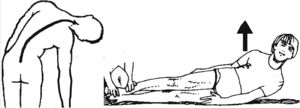
    En el movimiento de recuperación de la postura erecta tras la inclinación hacia delante, la región lumbar funciona como una palanca de 3.er grado.

  • •

    La lumbalgia inespecífica se produce en estas dos situaciones que ocupan toda la vida: el mantenimiento de la postura y el movimiento.

  • •

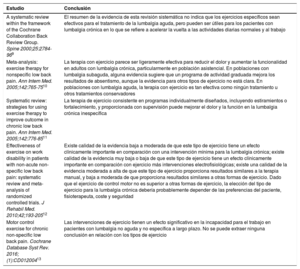
    El ejercicio es útil en la lumbalgia crónica para reducir el dolor, aumentar la funcionalidad y acelerar la vuelta a las actividades normales diarias y al trabajo.

  • •

    En el movimiento de todo el organismo actúan todos los músculos, bien de forma estática o bien dinámica.

  • •

    La práctica de cualquier tipo de ejercicio aeróbico puede servir para mantener una buena salud de la región lumbar en personas con posturas ortostáticas normales.

  • •

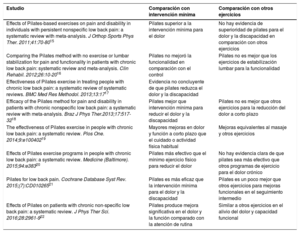
    El método pilates es útil en la lumbalgia crónica, pero en la misma medida que cualquier otro programa que se articule con ejercicios de la región lumbar.

  • •

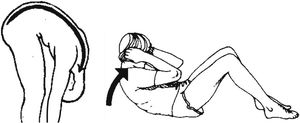
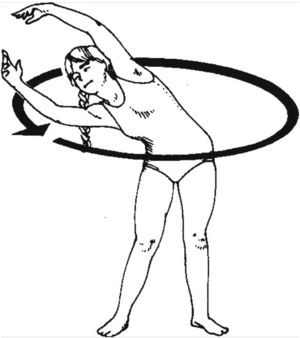
    A partir de las dos primeras semanas del comienzo de la lumbalgia, se puede iniciar un programa de ejercicios terapéuticos que trabajen la flexión, extensión, flexión lateral y rotación de la región lumbar.

  • •

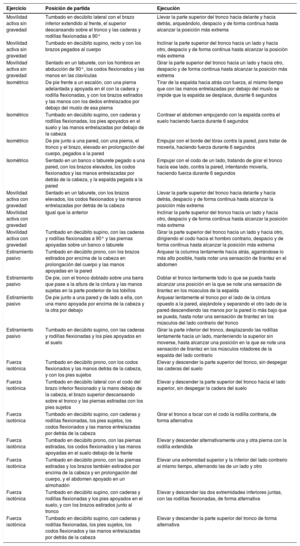
    En la hernia de disco se pueden hacer ejercicios isométricos de la musculatura abdominal porque no producen flexión de la región lumbar.

Palabras clave
Lumbalgia crónica
Ejercicio aeróbico
Ejercicios terapéuticos
Pilates
Yoga
Taichí

Identifíquese

¿Aún no es suscriptor de la revista?
Comprar el acceso al artículo

Comprando el artículo el pdf del mismo podrá ser descargado

Teléfono para incidencias

De lunes a viernes de 9h a 18h (GMT+1) excepto los meses de julio y agosto que será de 9 a 15h
Llamadas desde España 932 415 960
Llamadas desde fuera de España +34 932 415 960
Bibliografía
[1]
B.J. Shiple.
Treating low-back pain. Exercise knowns and unknowns.
Phys Sportsmed., (1997), 25 pp. 51-68
[2]
V. Akuthota, A. Ferreiro, T. Moore, M. Fredericson.
Core stability exercise principles.
Curr Sports Med Rep., (2008), 7 pp. 39-44
[3]
A. Vleeming, A.L. Pool-Goudzwaard, R. Stoeckart.
The posterior layer of the thoracolumbar fascia. Its function in load transfer from spine to legs.
Spine, (1985), 2 pp. 753-758
[4]
Anatomy and function of the trunk. En: Athletic ability and the anatomy of motion, Wolfe Medical Publ. Ltd, pp. 63-77
[5]
The muscular system. En: Principles of anatomy & physiology for physical training instructors, His Majesty's Stationery Office, pp. 28-90
[6]
S.A. Plowman.
Physical activity, physical fitness, and low back pain.
Williams & Wilkins, pp. 221-242
[7]
A.A. Joyce, D.H. Kotler.
Core Training in Low Back Disorders: Role of the Pilates Method.
Curr Sports Med Rep., (2017), 16 pp. 156-161
[8]
I. Vuori.
Dose-response of physical activity and low back pain, osteoarthritis, and osteoporosis.
Med Sci Sports Exerc., (2001), 6 pp. S551-S586
[9]
M. Van Tulder, A. Malmivaara, R. Esmail, B. Koes.
Exercise therapy for low back pain. A systematic review within the framework of the Cochrane Collaboration Back Review Group.
[10]
J.A. Hayden, M.W. Van Tulder, A. Malmivaara, B. Koes.
Meta-analysis: exercise therapy for nonspecific low back pain.
Ann Intern Med., (2005), 142 pp. 765-775
[11]
J.A. Hayden, M.W. Van Tulder, G. Tomlinson.
Systematic review: strategies for using exercise therapy to improve outcome in chronic low back pain.
Ann Intern Med., (2005), 142 pp. 776-785
[12]
P. Oesch, J. Kool, K. Birger Hagen, S. Bachmann.
Effectiveness of exercise on work disability in patients with non-acute non-specific low back pain: systematic review and meta-analysis of randomized controlled trials.
J Rehabil Med., (2010), 42 pp. 193-205
[13]
B.T. Saragiotto, C.G. Maher, T.P. Yamamoto, L.O. Costa, L.C. Menezes Costa, R.W. Ostelo, et al.
Motor control exercise for chronic non-specific low back pain.
Cochrane Database Syst Rev., (2016), pp. CD012004
[14]
R. Gordon, S. Bloxham.
A systematic review of the effects of exercise and physical activity on non-specific chronic low back pain.
Healthcare., (2016), 4 pp. 1-19
[15]
E.C. Lim, R.L. Poh, A.Y. Low, W.P. Wong.
Effects of Pilates-based exercises on pain and disability in individuals with persistent nonspecific low back pain: a systematic review with meta-analysis.
J. Orthop Sports Phys Ther., (2011), 41 pp. 70-80
[16]
L.M. Pereira, K. Obara, J.M. Dias, M.O. Menacho, D.A. Guariglia, D. Schiavoni, et al.
Comparing the Pilates method with no exercise or lumbar stabilization for pain and functionality in patients with chronic low back pain: systematic review and meta-analysis.
Clin Rehabil., (2012), 26 pp. 10-20
[17]
C. Wells, G.S. Kolt, P. Marshall, B. Hill, A. Bialocerkowski.
Effectiveness of Pilates exercise in treating people with chronic low back pain: a systematic review of systematic reviews.
BMC Med Res Methodol., (2013), 13 pp. 7
[18]
G.C. Miyamoto, L.O.P. Costa, T. Galvvanin, C.M.N. Cabral.
Efficacy of the Pilates method for pain and disability in patients with chronic nonspecific low back pain: a systematic review with meta-analysis.
Braz J Phys Ther., (2013), 17 pp. 517-532
[19]
C. Wells, G.S. Kolt, P. Marshall, B. Hill, A. Bielocerkowski.
The effectiveness of Pilates exercise in people with chronic low back pain: a systematic review.
Plos One., (2014), 9 pp. e100402
[20]
A. Patti, A. Bianco, A. Paoli, G. Messina, M.A. Montalbo, M. Bellafiore, et al.
Effects of Pilates exercise programs in people with chronic low back pain: a systematic review.
Medicine (Baltimore)., (2015), 94 pp. e383
[21]
T.P. Yamato, C.G. Maher, B.T. Saragiotto, M.J. Hancock, R.W.J.G. Ostelo, C.M.N. Cabral, et al.
Pilates for low back pain.
Cochrane Database Syst. Rev., (2015), pp. D010265
[22]
H.T. Lin, W.C. Hung, J.L. Hung, P.S. Wu, L.J. Liaw, J.H. Chang.
Effects of Pilates on patients with chronic non-specific low back pain: a systematic review.
J Phys Ther Sci., (2016), 28 pp. 2961-2969
[23]
H. Cramer, R. Lauche, H. Haller, G. Dobos.
A systematic review and meta-analysis of yoga for low back pain.
Clin J Pain., (2013), 29 pp. 450-460
[24]
S. Holtzman, R.T. Beggs.
Yoga for chronic low back pain: A meta-analysis of randomized controlled trials.
Pain Res Manag., (2013), 18 pp. 267-272
[25]
N. Skoetz, K. Pilkington, R. Vempati, C.R. D’Adamo, B.M. Berman, L.S. Wieland.
Yoga treatment for chronic non-specific low back pain.
Cochrane Database Syst Rev., (2017), pp. CD010671
[26]
A.M. Sawyer, S.K. Martinez, G.L. Warren.
Impact of yoga on low back pain and function: A systematic review and meta-analysis.
J Yoga Phys Ther., (2012), 2 pp. 1-4
[27]
P. Posadzki, E. Ernst.
Yoga for low back pain: a systematic review of randomized clinical trials.
[28]
L.J. Kong, R. Lauche, P. Klose, J.H. Bu, X.C. Yang, C.Q. Chao Qing Guo, et al.
Tai Chi for chronic pain conditions: A systematic review and meta-analysis of randomized controlled trials.
Sci Rep., (2016), 6 pp. 25325
[29]
Y.H. Cho.
Effects of Tai Chi on pain and muscle activity in young males with acute low back pain.
J Phys Ther Sci., (2014), 26 pp. 679-681
[30]
A.M. Hall, C.G. Maher, P. Lam, M. Ferreira, J. Latimer.
Tai chi exercise for treatment of pain and disability in people with persistent low back pain: a randomized controlled trial.
Arthritis Care Res (Hoboken)., (2011), 63 pp. 1576-1583
[31]
Therapeutic Exercise. Foundations and techniques, 6.ª ed, F.A. Davis Co.,
[32]
T.J. Trainor, M.A. Trainor.
Etiology of Low Back Pain in Athletes.
Curr Sports Med Rep., (2004), 3 pp. 41-46