




Vol. 28. Núm. 3.
Páginas 3-11 (Marzo 2021)

Capítulo 1
De la prescripción social a la recomendación de activos: ¿qué funciona, para quién, en qué contexto y cómo?

Sara Calderón-Larrañagaa*Fleur Braddickb
Doi : https://10.1016/j.fmc.2021.02.002
Opciones
Puntos para una lectura rápida

  • •

    La prescripción social o recomendación de activos puede entenderse como el proceso por el cual un profesional de la salud recomienda a un paciente “recursos” de su propia comunidad potencialmente beneficiosos para su salud y bienestar (también denominados “activos en salud”).

  • •

    Las iniciativas de prescripción social están estrechamente vinculadas a una concepción de la salud que pone el énfasis en los orígenes del bienestar (modelo salutogénico), en contraposición al tradicional enfoque occidental centrado en la enfermedad y sus causas (modelo patogénico).

  • •

    Los programas de prescripción social suelen estar dirigidos a pacientes que acuden a atención primaria, por lo que las recomendaciones suelen provenir de profesionales sanitarios y no sanitarios pertenecientes a dicho nivel asistencial. Sin embargo, la recomendación de activos no es patrimonio exclusivo del ámbito sanitario y puede realizarse desde otras entidades (municipales, asociativas) o la propia ciudadanía.

  • •

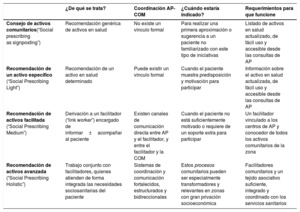
    Existen diferentes modelos de prescripción social según el nivel de coordinación entre las entidades comunitarias y los servicios sanitarios, los agentes implicados y las características y necesidades de los pacientes y comunidades de referencia (consejo de activos comunitarios, recomendación de un activo específico, recomendación de activos facilitada y avanzada).

  • •

    Las iniciativas de prescripción social son enormemente complejas. No solo por la multiplicidad de actores implicados y la existencia de diferentes modelos, sino también (sobre todo) porque se implementan y desarrollan en contextos político-sanitarios donde conviven múltiples (y con frecuencia, enfrentados) intereses y prioridades.

  • •

    La evidencia científica sobre la prescripción social requiere de nuevas aproximaciones metodológicas que permitan comprender “cómo”, “para quién” y “en qué contexto” pueden (o no) funcionar.

  • •

    Para que la prescripción social pueda responder a las particularidades y necesidades locales, fortalecer las dinámicas comunitarias existentes y mejorar la salud de las personas, debe constituirse de forma ascendente, potenciando en la medida de lo posible la participación comunitaria.

  • •

    La apuesta por la prescripción social debería acompañarse de medidas (políticas y presupuestarias) que refuercen los servicios de atención primaria y garanticen la sostenibilidad, suficiencia y calidad de los activos comunitarios en el medio-largo plazo.

Palabras clave
Prescripción social
Recomendación de activos
Salud comunitaria
Promoción de la salud
Atención primaria

Identifíquese

¿Aún no es suscriptor de la revista?
Comprar el acceso al artículo

Comprando el artículo el pdf del mismo podrá ser descargado

Teléfono para incidencias

De lunes a viernes de 9h a 18h (GMT+1) excepto los meses de julio y agosto que será de 9 a 15h
Llamadas desde España 932 415 960
Llamadas desde fuera de España +34 932 415 960
Bibliografía
[1]
R. Mossabir, R. Morris, A. Kennedy, C. Blickem, A. Rogers.
A scoping review to understand the effectiveness of linking schemes from healthcare providers to community resources to improve the health and well-being of people with long-term conditions.
Health Soc Care Community., (2015), 23 pp. 467-484
[2]
S. Moffatt, M. Steer, S. Lawson, L. Penn, N. O’Brien.
Link Worker social prescribing to improve health and well-being for people with long-term conditions: qualitative study of service user perceptions.
BMJ Open., (2017), 7 pp. e015203
[3]
M. Polley, M. Bertotti, R. Kimberlee, K. Pilkington, C. Refsum, A. Carpenter.
A review of the evidence assessing impact of social prescribing on healthcare demand and cost implications.
University of Westminster, (2017),
[4]
I.A. Belmonte, I.V. Guanyabens.
Recomendación de activos de la comunidad: ¿lo hacemos desde atención primaria?.
FMC., (2019), 26 pp. 420-423
[5]
C. Drinkwater, J. Wildman, S. Moffatt.
Social prescribing.
BMJ., (2019), 364 pp. l1285
[6]
National Health Service.
NHS Long Term Plan. London.
(2019),
[7]
Consejería de Salud.
Plan de Renovación de la Atención Primaria del Servicio Andaluz de Salud.
Junta de Andalucía, (2016),
[8]
M. Hernán, A. Cardo-Miota, J.F. Barranco-Tirado, C. Belda-Grindley, E. Paez-Muñoz, S.L. Rodriguez-Gymez.
Guía Salud Comunitaria Basada en Activos Andalucía.
Escuela Andaluza de Salud Pública, (2019),
[9]
S. López, O. Suárez, R. Cofiño.
Guía ampliada para la recomendación de activos (“prescripción social”) en el sistema sanitario.
Principado de Asturias. Observatorio de Salud en Asturias, (2018),
[10]
M. Hernán-García, D. García Blanco, J. Cibillo Llanes, R. Cofiño.
Fundamentos del enfoque de activos para la salud en atención primaria de salud.
FMC., (2019), 26 pp. 1-26
[11]
A. Antonovsky.
Unraveling the mystery of health: How people manage stress and stay well.
Jossey-Bass, (1987),
[12]
A. Antonovsky.
The salutogenic model as a theory to guide health promotion.
Health Promot Int., (2014), 11 pp. 11-18
[13]
Ways To Wellness. Patients. Disponible en: https://waystowellness.org.uk/patients/.
[14]
Macmillan Cancer Support. Social Prescribing for Cancer Patients. A guide for Primary Care Networks. Disponible en: https://www.macmillan.org.uk/_images/social-prescribing-network-guide_tcm9-355360.pdf.
[15]
A. Jensen.
Culture Vitamins – an Arts on Prescription project in Denmark.
Perspect Public Health, (2019), 139 pp. 131-136
[16]
P. Claffey, S. Sloan, C. Soraghan, G. Boyle, D.J. Robinson.
LAMP in Action: the Feasibility of Social Prescribing in the Medicine for the Elderly Outpatients.
Age Ageing., (2017), 46 pp. iii13-iii59
[17]
D.A. Taylor, G.M. Nicholls, A.D.J. Taylor.
Perceptions of Pharmacy Involvement in Social Prescribing Pathways in England.
Scotland and Wales. Pharmacy, (2019), 7 pp. 24
[18]
R. Kimberlee.
What is social prescribing?.
Adv Soc Sci Res J., (2015), 2
[19]
Public Health England.
Effectiveness of social prescribing - An evidence synthesis.
PHE publications, (2019),
[20]
L. Bickerdike, A. Booth, P.M. Wilson, K. Farley, K. Wright, P. Wilson.
Social prescribing: less rhetoric and more reality. A systematic review of the evidence.
BMJ Open., (2017), 7 pp. e013384
[21]
T.G. Pavey, A.H. Taylor, K.R. Fox, M. Hillsdon, N. Anokye, J.L. Campbell, et al.
Effect of exercise referral schemes in primary care on physical activity and improving health outcomes: systematic review and meta-analysis.
BMJ., (2011), 343 pp. d6462
[22]
H.J. Chatterjee, P.M. Camic, B. Lockyer, L.J.M. Thomson.
Non-clinical community interventions: a systematised review of social prescribing schemes.
Arts Health, (2018), 10 pp. 97-123
[23]
L.M. Gottlieb, H. Wing, N.E. Adler.
A Systematic Review of Interventions on Patients’ Social and Economic Needs.
Am J Prev Med., (2017), 53 pp. 719-729
[24]
J.V. Pescheny, G. Randhawa, Y. Pappas.
The impact of social prescribing services on service users: a systematic review of the evidence.
Eur J Public Health., (2020), 30 pp. 664-673
[25]
T. Greenhalgh, S. Thorne, K. Malterud.
Time to challenge the spurious hierarchy of systematic over narrative reviews?.
Eur J Clin Invest., (2018), 48 pp. e12931
[26]
T. Greenhalgh, C. Papoutsi.
Studying complexity in health services research: desperately seeking an overdue paradigm shift.
[27]
K. Pilkington, M. Loef, M. Polley.
Searching for Real-World Effectiveness of Health Care Innovations: Scoping Study of Social Prescribing for Diabetes.
J Med Internet Res., (2017), 19 pp. e20
[28]
S. Cohn, M. Clinch, C. Bunn, P. Stronge.
Entangled complexity: Why complex interventions are just not complicated enough.
J Health Serv Res Policy., (2013), 18 pp. 40-43
[29]
R.K. Valaitis, N. Carter, A. Lam, J. Nicholl, J. Feather, L. Cleghorn.
Implementation and maintenance of patient navigation programs linking primary care with community-based health and social services: a scoping literature review.
BMC Health Serv Res., (2017), 17 pp. 116
[30]
J.V. Pescheny, Y. Pappas, G. Randhawa.
Facilitators and barriers of implementing and delivering social prescribing services: a systematic review.
BMC Heal Serv Res., (2018), 18 pp. 86
[31]
B. Marchal, G. Westhorp, G. Wong, S. Van Belle, T. Greenhalgh, G. Kegels, et al.
Realist RCTs of complex interventions - An oxymoron.
Soc Sci Med., (2013), 94 pp. 124-128
[32]
K. Husk, K. Blockley, R. Lovell, A. Bethel, I. Lang, R. Byng, et al.
What approaches to social prescribing work, for whom, and in what circumstances?. A realist review.
Health Soc Care Community., (2019),
[33]
M. Bertotti, C. Frostick, P. Hutt, R. Sohanpal, D. Carnes.
A realist evaluation of social prescribing: an exploration into the context and mechanisms underpinning a pathway linking primary care with the voluntary sector.
Prim Health Care Res Dev., (2018), 19 pp. 232-245
[34]
M. Faulkner.
Supporting the psychosocial needs of patients in general practice: the role of a voluntary referral service.
Patient Educ Couns., (2004), 52 pp. 41-46
[35]
J. South, T.J. Higgins, J. Woodall, S.M. White.
Can social prescribing provide the missing link?.
Prim Health Care Res Dev, (2008), 9 pp. 310-318
[36]
K. Skivington, M. Smith, N.R. Chng, M. Mackenzie, S. Wyke, S.W. Mercer.
Delivering a primary care-based social prescribing initiative: a qualitative study of the benefits and challenges.
Br J Gen Pract., (2018), 68 pp. e487-e494
[37]
J.M. White, F. Cornish, S. Kerr.
Front-line perspectives on “joined-up” working relationships: a qualitative study of social prescribing in the west of Scotland.
Heal Soc Care Community, (2017), 25 pp. 194-203
[38]
E.S. Rempel, E.N. Wilson, H. Durrant, J. Barnett.
Preparing the prescription: a review of the aim and measurement of social referral programmes.
BMJ Open., (2017), 7 pp. e017734
[39]
Social Prescribing network.
Report of the annual Social Prescribing Network conference.
University of Westminster, Wellcome Trust, College of Medicine, (2016),
[40]
I. Torjesen.
Social prescribing could help alleviate pressure on GPs.
BMJ., (2016), 352 pp. i1436
[41]
J.T. Hart.
A New Kind of Doctor.
The Merlin Press, (1988),
[42]
T. Greenhalgh.
Primary Health Care. Theory and Practice.
Blackwell Publishing Ltd, (2007),
[43]
L.S. Levene, R. Baker, N. Walker, C. Williams, A. Wilson, J. Bankart.
Predicting declines in perceived relationship continuity using practice deprivation scores: a longitudinal study in primary care.
Br J Gen Pract., (2018), 68 pp. e420-e426
[44]
J. Tudor Hart.
The inverse care law.
[45]
R. Rosen.
Divided we fall: getting the best out of general practice.
Nuffield Trust, (2018),
[46]
B. Baird, H. Reeve, S. Ross, M. Honeyman, M. Nosa-Ehima, B. Sahib, et al.
Innovative models of general practice.
King's Fund, (2018),
[47]
M. Hancock.
Keynote Address. Paper presented at the Social Prescribing: Coming of age. In London.
(2018),
[48]
J. Popay, P. Attree, D. Hornby, B. Milton, M. Whitehead, B. French, et al.
Community engagement in initiatives addressing the wider social determinants of health. A rapid review of evidence on impact, experience and process.
Universities of Lancaster, Liverpool and Central Lancashire, (2007),
[49]
M. Garcés.
Común (sin ismo). Pensaré Cartoneras.
(2014),
[50]
National Audit Office.
Financial sustainability of local authorities 2018.
Ministry of Housing, Communities and Local Government, (2018),
[51]
Colectivo Silesia.
Si quieres Atención Primaria, díselo en los presupuestos.
(2017),
[52]
La Cabecera.
Colectivo Silesia. Re(re)formando la Atención Primaria.
(2018),
[53]
I. Williams, K. Allen, G. Plahe.
Reports of rationing from the neglected realm of capital investment: Responses to resource constraint in the English National Health Service.
[54]
Iona Healh. The Mystery of General Practice. Nuffield Trust; 199.