


Vol. 29. Núm. 4.
Páginas 209-218 (Abril 2022)

El caso de la osteoporosis

Alberto López García-FrancoabAna Pereira IglesiasabAnabel González PratsaElena Cardona Corrochanoa
Doi : https://10.1016/j.fmc.2021.10.005
Opciones
Resumen

Puntos para una lectura rápida

  • •

    La disminución de la densidad mineral ósea es un factor de riesgo de fractura más, no un criterio de enfermedad. La edad es el factor de riesgo más importante (siete veces más que el descenso de la DMO en fractura de cadera).

  • •

    La estrategia de realizar un cribado poblacional en mayores de 50 años no se sustenta. La mayoría de las sociedades científicas asumen la estrategia de valorar el riesgo de fractura en los próximos 10 años con escalas validadas y calibradas. La escala FRAX es la más ampliamente utilizada.

  • •

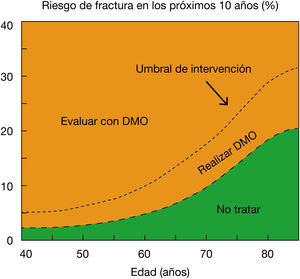
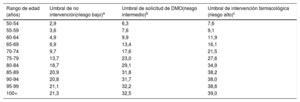
    Una estrategia para calibrar el riesgo y determinar los umbrales de intervención y tratamiento válida para nuestro entorno es la propuesta en 2015 por la DGFCM (diseñada con datos de fractura de cadera de la Comunidad de Madrid). El modelo propone valorar el riesgo de fractura de cadera en los próximos 10 años en función de la edad y de la puntuación de riesgo individual de la paciente. En mujeres con riesgo>10% recomiendan tratamiento sin necesidad de densitometría y en mujeres con riesgo<3% desaconsejan hacer ninguna intervención. En mujeres de riesgo intermedio (10-3%), recomiendan solicitar densitometría como prueba discriminante, valorando la indicación de tratamiento según la Z-score obtenida en la misma.

  • •

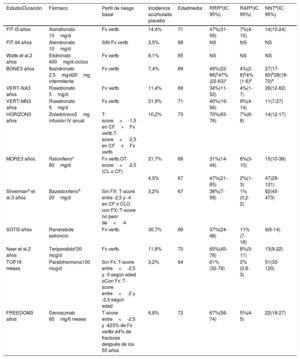
    No hay evidencia de eficacia de los tratamientos antifractura ni en prevención primaria ni en mujeres con densitometría en rango osteopénico: las poblaciones de los estudios de los distintos fármacos eran mujeres con AP de fracturas o <-2DS de T-score. Los fármacos han demostrado eficacia en fractura vertebral, pero hay escasa evidencia de su eficacia en fractura de cadera.

  • •

    No existen estudios en prevención primaria en mujeres<65 años, por lo que en ellas el riesgo debe ser individualizado. Asimismo, la decisión de tratar a mujeres>80 años debe ser también individualizada por su situación de pluripatología y polifarmacia.

  • •

    Los fármacos de primera elección son el alendronato (10mg/día o 70mg/semana VO) o risedronato (5mg/día, 35mg/s o 75mg/mes VO), que deben administrarse con suplementos de vitamina D (400-800 UI/día) y calcio (0,5-1,2g/día). El tratamiento no debe superar los 5 años de duración y el seguimiento de las pacientes ha de ser anual mediante la reevaluación clínica de las mismas (presencia de nuevos factores de riesgo o de nuevas fracturas osteoporóticas).

Palabras clave
Osteoporosis
Grupos de riesgo
Terapéutica
Uso excesivo de los servicios de salud.

Identifíquese

¿Aún no es suscriptor de la revista?
Comprar el acceso al artículo

Comprando el artículo el pdf del mismo podrá ser descargado

Teléfono para incidencias

De lunes a viernes de 9h a 18h (GMT+1) excepto los meses de julio y agosto que será de 9 a 15h
Llamadas desde España 932 415 960
Llamadas desde fuera de España +34 932 415 960
Bibliografía
[1]
D.L. Sackett.
Clinical diagnosis and clinical laboratory.
Clin Invest Med., (1978), 1 pp. 37-43
[2]
Revilla A, Alcaraz M, Isasi C, Jamart L, Lasheras L, López A, et al., Servicio Madrileño de Salud. Recomendaciones para la valoración y tratamiento de la osteoporosis primaria en mujeres de la Comunidad de Madrid. Madrid: Comunidad de Madrid. Consejería de Sanidad; 2015.
[3]
J.A. Kanis, F. Borgstrom, C. De Laet, H. Johansson, O. Johnell, B. Jonsson, et al.
Assessment of fracture risk.
Osteoporos Int., (2005), 16 pp. 581-589
[4]
K.L. Stone, D.G. Seeley, L.Y. Lui, J.A. Cauley, K. Ensrud, W.S. Browner, et al.
BMD at multiple sites and risk of fracture of multiple types: long-term results from the Study of Osteoporotic Fractures.
J Bone Miner Res., (2003), 18 pp. 1947-1954
[5]
N.D. Nguyen, J.A. Eisman, J.R. Center, T.V. Nguyen.
Risk factors for fracture in non-osteoporotic men and women.
J Clin Endocrinol Metab., (2007), 92 pp. 955-962
[6]
A. Cranney, G. Wells, A. Willian, I. Griffith, N. Zytaruk, V. Robinson, et al.
Meta-analysis of alendronate for the treatment of postmenopausal women.
Endocr Rev., (2002), 23 pp. 508-516
[7]
C.E. De Laet, B.A. van Hout, H. Burger, A. Hofman, H.A. Pols.
Bone density and risk of hip fracture in men and women: cross sectional analysis.
BMJ., (1997), 315 pp. 221-225
[8]
B. Dawson-Hughes.
National Osteoporosis Foundation Guide Committee. A revised clinician's guide to the prevention and treatment of osteoporosis.
J Clin Endocrinol Metab., (2008), 93 pp. 2463-2465
[9]
J.A. Kanis, O. Johnell, A. Oden, H. Johansson, E. McCloskey.
FRAX and the assessment of fracture probability in men and women from the UK.
Osteoporos Int., (2008), 19 pp. 385-397
[10]
N.D. Nguyen, S.A. Frost, J.R. Center, J.A. Eisman, T.V. Nguyen.
Development of prognostic nomograms for individualizing 5-year and 10-year fracture risks.
Osteoporos Int., (2008), 19 pp. 1431-1444
[11]
K.H. Rubin, M.J. Rothmann, T. Holmberg, M. Hoiberg, S. Moller, R. Barkmann, et al.
Effectiveness of a two-step population-based osteoporosis screening program using FRAX: the randomized Risk-stratified Osteoporosis Strategy Evaluation (ROSE) study.
Osteoporos Int., (2018), 29 pp. 567-578
[12]
L. Shepstone, E. Lenaghan, C. Cooper, S. Clarke, R. Fong-Soe-Khioe, R. Fordham, et al.
Screening in the community to reduce fractures in older women (SCOOP): a randomised controlled trial.
Lancet., (2018), 391 pp. 741-747
[13]
U.S. Preventive Services Task Force. Screening for osteoporosis: U.S. Preventive Services Task Force. Recommendation statement. Ann Inter Med. 2011; 154: 356-64.
[14]
Agency for Healthcare Research and Quality U.S. Department of Health and Human Services. 5600 Fishers Lane. Agency for Healthcare Research and Quality. Disponible en: www.ahrq.gov Contract No. HHSA-290-2012-00015-I, Task Order No. 6. AHRQ Publication No. 15-05226-EF-1 Jun 2018.
[15]
NICETA464: Biphosphonates for treating osteoporosis. Technology appraisal guidance. London: National Clinical Guideline Centre; 2017.
[16]
Scottish Intercollegiate Guidelines Network (SIGN). Management of osteoporosis and the prevention of fragility fractures. Edinburgh: SIGN; 2021. (SIGN publication no. 142). [Enero 2021]. Disponible en: http://www.sign.ac.uk.
[17]
A. Papaioannou, S. Morin, A.M. Cheung, S. Atkinson, J.P. Brown, S. Feldman, et al.
Clinical Practice Guidelines for the diagnosis and management of osteoporosis in Canada: summary.
CMAJ., (2010), 182 pp. 1864-1873
[18]
J.A. Kanis, N.C. Harvey, C. Cooper, H. Johansson, A. Odén, E.U. McCoskeg, et al.
A systematic review of intervention thresholds based on FRAX: A report prepared for the National Osteoporosis Guidelines Group and the International Osteoporosis Foundation.
Arch Osteoporos., (2016), 11 pp. 25
[19]
G.E.-H. Fuleihan, M. Chakhtoura, J.A. Cauley, N. Chamoun.
Worlwide Fracture.
J Clin Densitom, (2017), 20 pp. 397-424
[20]
J.A. Kanis, C. Cooper, R. Rizzoli, J.Y. Reginster.
on behalf of the Scientific Advisory Board of the European Society for Clinical and Economic Aspects of Osteoporosis (ESCEO) and the Committees of Scientific Advisors and National Societies of the International Osteoporosis Foundation (IOF). European guidance for the diagnosis and management of osteoporosis in postmenopausal women.
Osteoporos Int., (2019), 30 pp. 3-445
[21]
R. Azagra, G. Roca, G. Encabo, A. Aguyé, M. Zwart, S. Güell, et al.
FRAX® tool, the WHO algorithm to predict osteoporotic fractures: the first analysis of its discriminative and predictive ability in the Spanish FRIDEX cohort.
BMC Musculoskelet Disord., (2012), 13 pp. 204
[22]
A. López, J.A. Baeyens, E. Bailón, M.J. Iglesias, A. Ortega, P. Alonso, et al.
Grupo de la Mujer del PAPPS. Actividades preventivas en la mujer. Actualización PAPPS 2020.
Aten Primaria., (2020), 52 pp. 125-148
[23]
C. De Laet, A. Oden, H. Johansson, O. Johnell, B. Jonsson, J.A. Kanis.
The impact of the use of multiple risk indicators for fracture on case-finding strategies: a mathematical approach.
Osteoporos Int., (2005), pp. 313-318
[24]
M. Van der Klift, C.D. de Laet, H.A. Pols.
Assessment of fracture risk: who should be treated for osteoporosis?.
Best Pract Res Clin Rheumatol., (2005), 19 pp. 937-950
[25]
G. Rose.
Sick individuals and sick populations.
Int J Epidemiol., (2001), 30 pp. 427-432
[26]
Richards M. A report for the Secretary of State for Health by Professor Sir Mike Richards CBE. 2010. Crown Copyright: Department of Health.
[27]
P. Alonso Coello, A. López García-Franco, G. Guyatt, R. Moynihan.
Drugs for pre-osteoporosis: prevention or disease mongering?.
[28]
J.H. Byun, S. Jang, S. Park, H.K. Yoon, B.H. Yoon, Y.C. Ha.
The efficacy of bisphosphonates for prevention of osteoporotic fracture: an update meta-analysis.
J Bone Metab., (2017), 24 pp. 37-49
[29]
T.L. Järvinen, K. Michaëlsson, J. Jokihaara, G.S. Collins, T.L. Perry, B. Mintzes, et al.
Overdiagnosis of bone fragility in the quest to prevent hip fracture.
BMJ., (2015), 350 pp. h2088
[30]
B. Ettinger, D.M. Black, B.H. Mitlak, R.K. Knickerbocker, T. Nickelsen, H.K. Genant, et al.
Reduction of vertebral fracture risk in postmenopausal women with osteoporosis treated with raloxifene: results from a 3-year randomized clinical trial. Multiple Outcomes of Raloxifene Evaluation (MORE) Investigators.
JAMA., (1999), 282 pp. 637-645
[31]
S.R. Cummings, D.M. Black, D.E. Thompson, W.B. Applegate, E. Barrett-Connor, T.A. Musliner, et al.
Effect of alendronate on risk of fracture in women with low bone density but without vertebral fractures: results from the Fracture Intervention Trial.
JAMA., (1998), 280 pp. 2077-2082
[32]
R.G. Crilly, M. Kloseck, B. Chesworth, S. Mequanint, E. Sadowski, J. Gilliland.
Comparison of hip fracture and osteoporosis medication prescription rates across Canadian provinces.
Osteoporos Int., (2014), 25 pp. 205-210
[33]
E. Seeman.
To stop or not stop, that is the question.
Osteoporos Int., (2009), 20 pp. 187-195
[34]
P.M. Camacho, S.M. Petak, N. Binkley, D.L. Diab, L.S. Eldeiry, A. Farooki, et al.
American Association of Clinical Endocrinologists/American College Of Endocrinology Clinical Practice Guidelines For The Diagnosis and Treatment Of Postmenopausal Osteoporosis-2020 Update.
Endocr Practice., (2020), 26 pp. 1-46
[35]
N.B. Watts, S.T. Harris, H.K. Genant, R.D. Wasnich, P.D. Miller, R.D. Jackson, et al.
Intermittent cyclical etidronate treatment of postmenopausal osteoporosis.
N Engl J Med., (1990), 323 pp. 73-79
[36]
C.H. Chesnut III, A. Skag, C. Christiansen, R. Recker, J.A. Stakkestad, A. Hoiseth, et al.
Oral Ibandronate Osteoporosis Vertebral Fracture Trial in North America and Europe (BONE). Effects of oral ibandronate administered daily or intermittently on fracture risk in postmenopausal osteoporosis.
J Bone Miner Res., (2004), 19 pp. 1241-1249
[37]
S.R. Cummings, S. Ferrari, R. Eastell, N. Gilchrist, Jensen J-EB, M. McClung, et al.
Vertebral fractures after discontinuation of denosumab: a post hoc analysis of the randomized placebo-controlled FREEDOM trial and its extension.
J Bone Miner Res., (2018), 33 pp. 190-198
[38]
M.M. Sanz.
Agencia Española de Medicamentos y Productos Sanitarios (AEMPS). Denosumab (Prolia®): posible riesgo de fracturas vertebrales múltiples tras la suspensión del tratamiento.
Panorama actual del medicamento., (2019), 43 pp. 818-822
[39]
K.E. Ensrud, J.L. Stock, E. Barrett-Connor, D. Grady, L. Mosca, K.T. Khaw, et al.
Effects of raloxifene on fracture risk in postmenopausal women: the Raloxifene Use for the Heart Trial.
Journal of Bone and Mineral Research., (2008), 23 pp. 112-120
[40]
Medicines Health Regulatory Agency. Strontium ranelate (Protelos): risk of serious cardiac disorders - restricted indications, new contraindications, and warnings. [citado Mar 2021]. Disponible en: http://www.mhra.gov.uk/home/groups/dsu/documents/publication/con267913.pdf.
[41]
Chessnut ChH, S. Silverman, K. Andriano, H. Genant, A. Gimona, S. Harris, et al.
A randomized trial of nasal spray salmon calcitonin in postmenopausal women with established osteoporosis: the prevent recurrence of osteoporotic fractures Study.
Am J Med., (2001), 109 pp. 267-276
[42]
R.A. Overman, M. Borse, M.L. Gourlay.
Salmon calcitonin use and associated cancer risk.
Annals of Pharmacotherapy, (2013), 47 pp. 675-1684
[43]
H.A. Bischoff-Ferrari, W.C. Willett, E.J. Orav, P. Lips, P.J. Meunier, R.A. Lyons, et al.
A pooled analysis of vitamin D dose requirements for fracture prevention.
N Engl J Med., (2012), 367 pp. 40-49
[44]
D.P. Trivedi, R. Doli, K.T. Khaw.
Effect of four monthly oral vitamin D3 (cholecalciferol) supplementation on fractures and mortality in men and women living in the community: randomized double blind controlled trial.
BMJ., (2003), 326 pp. 7387-7469
[45]
H.A. Bischoff-Ferrari, W.C. Willet, J.B. Wong, E. Giovannucci, T. Dietrich, B. Dawson Hughes.
Fracture Prevention with Vitamin D supplementation. A meta-analysis of Randomized controlled trials.
JAMA., (2005), 293 pp. 2257-2264
[46]
H.A. Bischoff-Ferrari, W.C. Willet, J.B. Wong, A.E. Stuck, H.B. Staehelin, J. Orav, et al.
Prevention of non-vertebral fractures with oral vit D and dose dependency.
Arch Intern Med., (2009), 169 pp. 551-561
[47]
B.M.P. Tang, G.D. Eslick, C. Nowson, C. Smith, A. Bensoussan.
Use of calcium or calcium in combination with vitamin D supplementation to prevent fractures and bone loss in people aged 50 years and older: a meta-analysis.
Lancet., (2007), 370 pp. 657-666
[48]
B. Dawson-Hughes, S. Harris, E. Krall, D. Ge.
Effect of calcium and vitamin D supplementation on bone density in men and women 65 years of age or older.
N Engl J Med., (1997), 337 pp. 670-676
[49]
The DIPART Group (vit D Individual Patient Analysis of Randomized Trials Group). Patient level pooled analysis of 68.500 patients from seven major vitamin D fracture trials in US and Europe. BMJ. 2010; 340: b5463.
[50]
M.J. Bolland, A. Grey, A. Avenell.
Effects of vitamin D supplementation on musculoskeletal health: a systematic review, meta-analysis, and trial sequential analysis.
Lancet Diabetes Endocrinol., (2018), 6 pp. 847-858
[51]
J.-G. Zhao, X.-T. Zeng, J. Wang, L. Liu.
Association Between Calcium or Vitamin D Supplementation and Fracture Incidence in Community-Dwelling Older Adults.
[52]
D.E. Roth, M. Leung, E. Mesfin, H. Qamar, J. Watterworth, E. Papp.
Vitamin D supplementation during pregnancy: state of the evidence from a systematic review of randomised trials.
BMJ., (2017), 359 pp. 5237
[53]
R.D. Jackson, A.Z. LaCroix, M. Gass, R.B. Wallace, J. Robbins, C.E. Lewis, et al.
Womeńs Health Initiative Investigators. Calcium plus vitamin D supplementation and the risk of fractures.
N Engl J Med., (2006), 354 pp. 669-683
[54]
J. Porthouse, S. Cockayne, C. King, L. Saxon, E. Steele, T. Aspray, et al.
Randomised controlled trial of calcium and supplementation with cholecalciferol (vitamina D3) for prevention of fractures in primary care.
[55]
The RECORD trial group. Oral vitamin D3 and calcium for secondary prevention of low trauma fractures in elderly people (Randomised evaluation of calcium or vitamin D, RECORD): a randomised placebo-controlled trial. Lancet. 2005; 365:1621-8.
[56]
I.R. Reid, M.J. Bolland, A. Grey.
Effect of calcium supplementation on hip fractures.
Osteoporos Int., (2008), 19 pp. 1119-1123
[57]
H.A. Bischoff-Ferrari, B. Dawson-Hughes, J.A. Baron, P. Burckhardt, R. Li, D. Spiegelman, et al.
Calcium intake and hip fracture risk in men and women: a meta-analysis of prospective cohort studies and randomized controlled trials.
Am J Clin Nutr., (2007), 86 pp. 1780-1790
[58]
K.M. Sanders, A.L. Stuart, E.J. Williamson, J.A. Simpson, M.A. Kotowicz, D. Young, et al.
Annual high-dose oral vitamin D and falls and fractures in older women: a randomized controlled trial.
JAMA., (2010), 303 pp. 1815-1822
[59]
M.J. Bolland, A. Grey, A. Avenell, G.D. Gamble, I.R. Reid.
Calcium supplements with or without vitamin D and risk of cardiovascular events: reanalysis of the Women's Health Initiative limited access dataset and meta-analysis.
BMJ., (2011), 342 pp. d2040
[60]
M.J. Bolland, A. Grey, A. Avenell.
Effects of vitamin D supplementation on musculoskeletal health: a systematic review, meta-analysis, and trial sequential analysis.
Lancet Diabetes Endocrinol., (2018), 6 pp. 847-858
[61]
M. Chung, J. Lee, T. Terasawa, J. Lau, T.A. Trikalinos.
Vitamin D With or Without Calcium Supplementation for Prevention of Cancer and Fractures: An Updated Meta-analysis for the U.S.
Preventive Services Task Force. Ann Intern Med., (2011), 155 pp. 827-838
[62]
D.C. Grossman, S.J. Curry, D.K. Owens, M.J. Barry, A.B. Caughey, K.W. Davidson, et al.
Vitamin D, calcium, or combined supplementation for the primary prevention of fractures in community-dwelling adults: US Preventive Services Task Force Recommendation Statement.
JAMA., (2018), 319 pp. 1592-1599