

Vol. 27. Núm. 7.
Páginas 345-348 (Agosto 2020)

¿Qué debería saber el médico de familia sobre…?
Ensayos clínicos de no inferioridad

Andrea Molina Nadal
Doi : https://10.1016/j.fmc.2019.11.011
Opciones
Puntos para una lectura rápidabstract

  • •

    El objetivo de los ensayos de no inferioridad es demostrar que un nuevo tratamiento no es menos eficaz (no es inferior) que el tratamiento estándar.

  • •

    Los ensayos de no inferioridad son útiles para fármacos que no se espera que sean más eficaces que el tratamiento estándar, pero que presentan potenciales ventajas en seguridad, posología o coste.

  • •

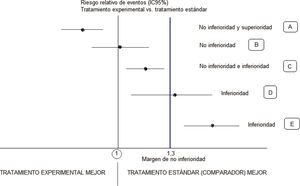
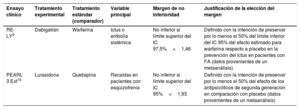
    La selección del margen de no inferioridad es clave; se basa en una combinación de razonamiento estadístico y juicio clínico y suele realizarse basándose en los datos conocidos de eficacia del tratamiento estándar respecto a placebo.

  • •

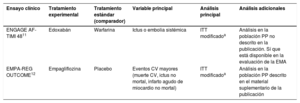
    Este tipo de ensayos presentan una serie de particularidades que es importante conocer para poder interpretar los resultados de forma adecuada.

Palabras clave
No inferioridad
Margen de no inferioridad
Análisis por protocolo
Intervalo de confianza
Lectura crítica

Identifíquese

¿Aún no es suscriptor de la revista?

Comprar el acceso al artículo

Comprando el artículo el pdf del mismo podrá ser descargado

Teléfono para incidencias

De lunes a viernes de 9h a 18h (GMT+1) excepto los meses de julio y agosto que será de 9 a 15h

Llamadas desde España 932 415 960
Llamadas desde fuera de España +34 932 415 960
Bibliografía
[1]
Committee for proprietary medicinal products (CPMP). Points to consider on switching between superiority and non-inferiority. CPMP/EWP/482/99. London (United Kingdom): European Agency for the Evaluation of Medicinal Products (EMA); julio 2000 [citado octubre 2019]. Disponible en: https://www.ema.europa.eu/en/documents/scientific-guideline/points-consider-switching-between-superiority-non-inferiority_en.pdf.
[2]
Committe for Medicinal Products for Human Use (CHMP). Guideline on the choice of the non-inferiority margin. EMEA/CPMP/EWP/2158/99. London (United Kingdom): European Medicines Agency (EMA); julio 2005 [citado octubre 2019]. Disponible en: https://www.ema.europa.eu/en/documents/scientific-guideline/guideline- choice-non-inferiority-margin_en.pdf.
[3]
L. Mauri, R.B. D’Agostino.
Challenges in the Design and Interpretation of Noninferiority Trials.
N Engl J Med., (2017), 377 pp. 1357-1367
[4]
T.A. Althunian, A. de Boer, R.H.H. Groenwold, O.H. Klungel.
Defining the noninferiority margin and analysing noninferiority: An overview.
Br J Clin Pharmacol., (2017), 83 pp. 1636-1642
[5]
I. Ferreira-González.
Bases para la interpretación de los estudios de no inferioridad: a propósito de los estudios ROCKET–AF, RE-LY y ARISTOTLE.
Rev Esp Cardiol., (2014), 67 pp. 432-435
[6]
A. Mounsey, A. Viera, R. Dominik.
7 questions to ask when evaluating a noninferiority trial.
J Fam Pract., (2014), 63 pp. E4-E8
[7]
J. Schumi, J.T. Wittes.
Through the looking glass: understanding non-inferiority.
[8]
G. Piaggio, D.R. Elbourne, D.G. Altman, S.J. Pocock, S.J. Evans, CONSORT Group.
Reporting of noninferiority and equivalence randomized trials: an extension of the CONSORT statement.
JAMA., (2006), 295 pp. 1152-1160
[9]
S.J. Connolly, M.D. Ezekowitz, S. Yusuf, J. Eikelboom, J. Oldgren, A. Parekh, et al.
Dabigatran versus warfarin in patients with atrial fibrillation.
N Engl J Med., (2009), 361 pp. 1139-1151
[10]
A. Loebel, J. Cucchiaro, J. Xu, K. Sarma, A. Pikalov, J.M. Kane.
Effectiveness of lurasidone vs. quetiapine XR for relapse prevention in schizophrenia: a 12-month, double-blind, noninferiority study.
Schizophr Res., (2013), 147 pp. 95-102
[11]
R.P. Giugliano, C.T. Ruff, E. Braunwald, S.A. Murphy, S.D. Wiviott, J.L. Halperin, et al.
Edoxaban versus warfarin in patients with atrial fibrillation.
N Engl J Med., (2013), 369 pp. 2093-2104
[12]
B. Zinman, C. Wanner, J.M. Lachin, D. Fitchett, E. Bluhmki, S. Hantel, et al.
Empagliflozin, Cardiovascular Outcomes, and Mortality in Type 2 Diabetes.
N Engl J Med., (2015), 373 pp. 2117-2128