





Vol. 27. Núm. 7.
Páginas 353-367 (Agosto 2020)

Terapéutica en APS
Fármacos con carga anticolinérgica: aspectos prácticos y precauciones

Ángela María Villalba-MorenoaEva Rocío Alfaro-LaraaSusana Sánchez-Fidalgob
Doi : https://10.1016/j.fmc.2019.11.012
Opciones
Puntos para una lectura rápida

  • •

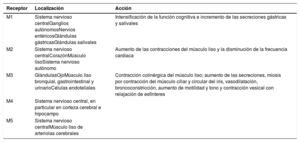
    Los fármacos anticolinérgicos son ampliamente utilizados en la práctica clínica por su efecto relajante en el músculo liso y, debido a la distribución de los receptores muscarínicos en el organismo, dan lugar a reacciones adversas, tanto a nivel periférico como central.

  • •

    Los fármacos anticolinérgicos son muy utilizados en la población geriátrica, la cual, debido a sus cambios farmacocinéticos y farmacodinámicos, así como a su menor actividad anticolinérgica basal, tienen mayor riesgo de sufrir reacciones adversas anticolinérgicas.

  • •

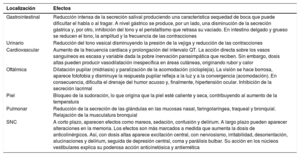
    Los efectos adversos más acusados en la población mayor son: xerostomía, problemas oculares, estreñimiento, retención urinaria, taquicardia, mareos, somnolencia y alteraciones cognitivas.

  • •

    La denominada “cascada terapéutica” en el anciano, es decir, la sucesión encadenada de prescripciones en la que un fármaco produce un efecto adverso que no se reconoce como tal y se trata con otro fármaco, aumenta el riesgo de producir reacciones adversas anticolinérgicas.

  • •

    Se define carga anticolinérgica como el efecto acumulativo de tomar uno o más medicamentos con capacidad para desarrollar efectos adversos anticolinérgicos.

  • •

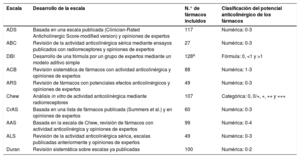
    Existen herramientas o escalas que estiman el mayor o menor riesgo de sufrir efectos adversos anticolinérgicos y que, generalmente, se trata de listas de medicamentos con una puntuación creciente según su actividad anticolinérgica.

  • •

    Las escalas más utilizadas son, por un lado, el Drug Burden Index en pacientes mayores que viven en comunidad, la cual tiene en cuenta fármacos anticolinérgicos y sedantes, y, por otro, la Anticholinergic Risk Scale y la Anticholinergic Cognitive Burden, que son las más frecuentes en pacientes institucionalizados y con demencia, respectivamente.

  • •

    El paciente pluripatológico, por sus características, pertenece a un grupo de especial fragilidad clínica con un importante riesgo de sufrir los efectos anticolinérgicos.

  • •

    La “Anticholinergic Burden Calculator” es una herramienta web que calcula la carga anticolinérgica que recibe un paciente basándose en diez escalas anticolinérgicas diferentes identificadas en una revisión sistemática en pacientes con características similares al pluripatológico.

  • •

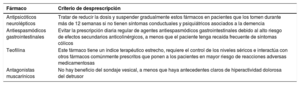
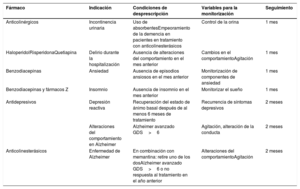
    Para la revisión del tratamiento en un paciente mayor, es recomendable comprobar la carga anticolinérgica y siempre que sea posible, retirar progresivamente, sustituir si el tratamiento farmacológico no puede ser suspendido y/o disminuir la dosis a la mínima eficaz.

Palabras clave
Carga anticolinérgica
Multimorbilidad
Polifarmacia
Pluripatológico
Reacciones adversas anticolinérgicas

Identifíquese

¿Aún no es suscriptor de la revista?
Comprar el acceso al artículo

Comprando el artículo el pdf del mismo podrá ser descargado

Teléfono para incidencias

De lunes a viernes de 9h a 18h (GMT+1) excepto los meses de julio y agosto que será de 9 a 15h
Llamadas desde España 932 415 960
Llamadas desde fuera de España +34 932 415 960
Bibliografía
[1]
B. Katzung, A. Trevor.
Basic & Clinical Pharmacology.
14. ª ed, McGraw-Hill Education, (2017),
[2]
J. Florez.
Farmacología humana.
6. ª ed, Elsevier Masson, (2014),
[3]
D.E. Golan.
Principles of Pharmacology: the pathophysiologic basis of drug therapy.
4. ª ed, Wolters Kluwer Health, (2017),
[4]
C. Fox, K. Richardson, I. Maidment, G. Savva, D. Matthe, S. Coulton, et al.
Anticholinergic medication use and cognitive impairment in the older population: the medical research council cognitive function and ageing study.
J Am Geriatr Soc., (2011), 59 pp. 1477-1483
[5]
S. Chatterjee, S. Mehta, J.T. Sherer, R.R. Aparasu.
Prevalence and predictors of anticholinergic medication use in elderly nursing home residents with dementia: analysis of data from the 2004 National Nursing Home Survey.
Drugs Aging., (2010), 27 pp. 987-997
[6]
N. López-Matons, D. Conill-Badell, G. Obrero-Cusidó, D. Gil-Saladié, J. Padrós-Selma, A. Martin-Lopez.
Anticholinergic drugs and cognitive impairment in the elderly.
Med Clin (Barc)., (2018), 151 pp. 141-144
[7]
E.R. Alfaro-Lara, B. Santos-Ramos, A. González-Méndez, M. Galván-Banqueri, M.D. Vega-Coca, M.D. Nieto-Martín, et al.
Medication reconciliation on hospital admission in patients with multiple chronic diseases using a standardized methodology.
Rev Esp Geriatr Gerontol., (2013), 48 pp. 103-108
[8]
S. Shi, U. Klotz.
Age-related changes in pharmacokinetics.
Curr Drug Metab., (2011), 12 pp. 601-610
[9]
D.S. Budnitz, M.C. Lovegrove, N. Shehab, C.L. Richards.
Emergency hospitalizations for adverse drug events in older Americans.
N Engl J Med., (2011), 365 pp. 2002-2012
[10]
J. López, M.A. Zea, L. Aguera, M.A. Fernádez, M. Valentí, P. Martínez.
Efecto de los fármacos anticolinérgicos en el rendimiento cognitivo de las personas mayores.
Rev Psiquiatr Salud Ment (Barc)., (2015), 8 pp. 35-43
[11]
A. Desoutter, M. Soudain-Pineau, F. Munsch, C. Mauprivez, T. Dufour, J.L. Coeuriot.
Xerostomia and medication: a cross-sectional study in long-term geriatric wards.
J Nutr Health Aging., (2012), 16 pp. 575-579
[12]
W.M. Thomson.
Dry mouth and older people.
Aust Dent J., (2015), 60 pp. 54-63
[13]
F. Formiga, J. Mascaro, A. Vidaller, R. Pujol.
Xerostomía en el paciente anciano.
Rev Mult Gerontol., (2003), 13 pp. 24-28
[14]
A. Mounsey, M. Raleigh, A. Wilson.
Management of constipation in older adults.
Am Fam Physician., (2015), 92 pp. 500-504
[15]
C. Jackson, N. Wenger.
Enfermedad cardiovascular en el anciano.
Rev Esp Cardiol., (2011), 64 pp. 697-712
[16]
V. Kalish, J. Gillham, B. Unwin.
Delirium in older persons: evaluation and management.
Am Fam Physician., (2014), 90 pp. 150-157
[17]
J.L. Rudolph, M.J. Salow, M.C. Angelini, R.E. McGlinchey.
The anticholinergic risk scale and anticholinergic adverse effects in older persons.
Arch Intern Med., (2008), 168 pp. 508-513
[18]
L. Tune.
Anticholinergic effects of medication in elderly patients.
J Clin Psychiatry., (2001), 62 pp. 11-14
[19]
K. Ruxton, R. Woodman, A. Mangoni.
Drugs with anticholinergic effects and cognitive impairment, falls and all-cause mortality in older adults: A systematic review and meta-analysis.
Br J Clin Pharmacol., (2015), 80 pp. 209-220
[20]
J. López-Álvarez, M.A. Zea-Sevilla, L. Agüera-Ortiz, M.A. Fernández-Blázquez, M. Valentí-Soler, P. Martínez-Martín.
Effect of anticholinergic drugs on cognitive impairment in the elderly.
Rev Psiquiatr Salud Ment., (2015), 8 pp. 35-53
[21]
L. Tune, S. Egeli.
Acetylcholine and delirium.
Dement Geriatr Cogn Disord., (1999), 10 pp. 342-344
[22]
L.E. Tune, J.T. Coyle.
Serum levels of anticholinergic drugs in the treatment of acute extrapyramidal side effects.
Arch Gen Psychiatry., (1980), 37 pp. 293-297
[23]
H. Brath, N. Mehta, R.D. Savage, S.S. Gill, W. Wu, S.E. Bronskill, et al.
What is known about preventing, detecting, and reversing prescribing cascades: a scoping review.
J Am Geriatr Soc., (2018), 66 pp. 2079-2085
[24]
H. Kersten, T. Bruun.
Anticholinergic Drug Burden in Older People's Brain. How well is it Measured?.
Basic Clin Pharmacol Toxicol., (2014), 114 pp. 151-159
[25]
P. Lampela, P. Lavikainen, J.A. Garcia-Horsman, J.S. Bell, R. Huupponen, S. Hartikainen.
Anticholinergic drug use, serum anticholinergic activity, and adverse drug events among older people: a population-based study.
Drugs Aging., (2013), 30 pp. 321-330
[26]
L.F. Low, K.J. Anstey, P. Sachdev.
Use of medications with anti-cholinergic properties and cognitive function in a young-old community sample.
Int J Geriatr Psychiatry., (2009), 24 pp. 578-584
[27]
L.M. Kalisch Ellett, N.L. Pratt, E.N. Ramsay, J.D. Barratt, E.E. Roughead.
Multiple anticholinergic medication use and risk of hospital admission for confusion or dementia.
J Am Geriatr Soc., (2014), 62 pp. 1916-1922
[28]
N.L. Campbell, M.A. Boustani, K.A. Lane, S. Gao, H. Hendrie, B.A. Khan, et al.
Use of anticholinergics and the risk of cognitive impairment in an African American population.
Neurology., (2010), 75 pp. 152-159
[29]
S.N. Hilmer, D.E. Mager, E.M. Simonsick, Y. Cao, S.M. Ling, B.G. Windham, et al.
A Drug Burden Index to define the functional burden of medications in older people.
Arch Intern Med., (2007), 167 pp. 781-787
[30]
D. Gnjidic, J.S. Bell, S.N. Hilmer, E. Lönnroos, R. Sulkava, S. Hartikainen.
Drug Burden Index associated with function in community-dwelling older people in Finland: a cross-sectional study.
Ann Med., (2012), 44 pp. 458-467
[31]
L. Pasina, C.D. Djade, U. Lucca, A. Nobili, M. Tettamanti, C. Franchi, et al.
Association of anticholinergic burden with cognitive and functional status in a cohort of hospitalized elderly: comparison of the Anticholinergic Cognitive Burden Scale and anticholinergic risk scale: results from the REPOSI study.
Drugs Aging., (2013), 30 pp. 103-112
[32]
M. Ollero Baturone, M. Bernabéu Wittel, J.M. Espinosa Almendro, R. Garcia Estepa, J.C. Morilla Herrera, B. Pascual de la Pisa, et al.
Proceso Asistencial Integrado. Atención al Paciente Pluripatológico.
3. ª ed, Consejería de Salud, (2018),
[33]
A.M. Villalba-Moreno, E.R. Alfaro-Lara, M.C. Pérez-Guerrero, M.D. Nieto-Martin, B. Santos-Ramos.
Systematic review on the use of anticholinergic scales in poly-pathological patients.
Arch Gerontol Geriatr., (2016), 62 pp. 1-8
[34]
T.J. Welsh, V. van der Wardt, G. Ojo, A.L. Gordon, J.R.F. Gladman.
Anticholinergic Drug Burden Tools/Scales and Adverse Outcomes in Different Clinical Settings: A Systematic Review of Reviews.
Drugs Aging., (2018), 35 pp. 523-538
[35]
R. Kane, J. Ouslander, I. Abrass.
Geriatría Clínica.
3. ª ed, McGraw Hill, (2000),
[36]
N.M. Wilson, S.N. Hilmer, L.M. March, I.D. Cameron, S.R. Lord, M.J. Seibel, et al.
Associations between drug burden index and falls in older people in residential aged care.
J Am Geriatr Soc., (2011), 59 pp. 875-880
[37]
A. Villalba-Moreno, E. Alfaro-Lara, S. Sánchez-Fidalgo, B. Santos-Ramos.
Anticholinergic Burden Calculator [Internet]. Seville.
(2016),
[38]
A.H. Lavan, P. Gallagher, C. Parsons, D. O’Mahony.
STOPPFrail (Screening Tool of Older Persons Prescriptions in Frail adults with limited life expectancy): consensus validation.
Age Ageing., (2017), 46 pp. 600-607
[39]
A. Rodríguez-Pérez, E.R. Alfaro-Lara, S. Albiñana-Pérez, M.D. Nieto-Martín, J. Díez-Manglano, C. Pérez-Guerrero, et al.
Novel tool for deprescribing in chronic patients with multimorbidity: list of evidence-based deprescribing for chronic patients criteria.
Geriatr Gerontol Int., (2017), 17 pp. 2200-2207
[40]
Centro de información online de medicamentos de la AEMPS – CIMA. España: Agencia Española de Medicamentos y Productos Sanitarios 2017 [acceso 15 de octubre de 2019]. Disponible en: https://cima.aemps.es/cima/publico/home.html.
[41]
J.M. Garcia-Herrera Pérez Bryan, E.V. Nogueras Morillas, F. Muñoz Cobos.
Guía de Práctica Clínica para el tratamiento de la depresión en Atención Primaria.
Distrito Sanitario Málaga-UGC Salud Mental Hospital Universitario “Carlos Haya”, (2011),
[42]
S. Fuentes Cuenca, E. Mérida Casado.
Protocolo terapéutico de la depresión en el anciano.
Medicine., (2011), 10 pp. 5851-5854
[43]
P.S. Nishtala, S.N. Hilmer, A.J. McLachlan, P.J. Hannan, T.F. Chen.
Impact of residential medication management reviews on drug burden index in aged-care homes: a retrospective analysis.
Drugs Aging., (2009), 26 pp. 677-686
[44]
M.H. Beers, J.G. Ouslander, I. Rollingher, D.B. Reuben, J. Brooks, J.C. Beck.
Explicit criteria for determining inappropriate medication use in nursing home residents. UCLA Division of Geriatric Medicine.
Arch Intern Med., (1991), 151 pp. 1825-1832
[45]
M.J. Samuel.
American Geriatrics Society 2015 updated Beers criteria for potentially inappropriate medication use in older adults.
J Am Geriatr Soc., (2015), 63 pp. 2227-2246
[46]
Centro Andaluz de Documentación e Información de medicamentos. Benzodiazepinas: riesgos y estrategias para su retirada. [Internet]. Granada; 2014 [acceso 25 septiembre de 2019]. Disponible en: http://www.cadime.es/es/boletin_terapeutico_andaluz.cfm?bid=179#.XbQOo5ozY2w.
[47]
E. Delgado Silveira, M. Muñoz García, B. Montero Errasquin, C. Sánchez Castellano, P.F. Gallagher, A.J. Cruz-Jentoft.
Inappropriate prescription in older patients: the STOPP/START criteria.
Rev Esp Geriatr Gerontol., (2009), 44 pp. 273-279
[48]
P. Hereu, A. Vallano.
Uso de antipsicóticos en pacientes con demencia.
Rev Esp Geriatr Gerontol., (2011), 46 pp. 50-53