
Vol. 27. Núm. 3.
Páginas 20-30 (Marzo 2020)

Capítulo 4
Infecciones víricas. Molluscum contagiosum, herpes simple genital, papilomavirus humanos (verrugas anogenitales) y hepatitis B y C

Lidia Montulla*Josep Manel Casanovab
Doi : https://10.1016/j.fmc.2020.03.003
Opciones
Puntos para una lectura rápida

  • •

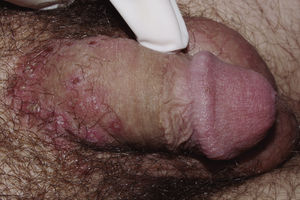
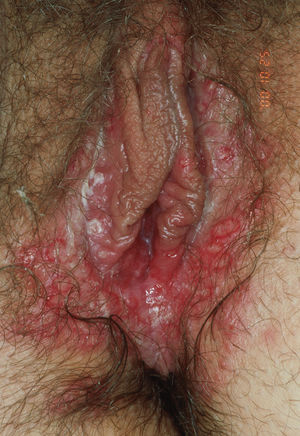
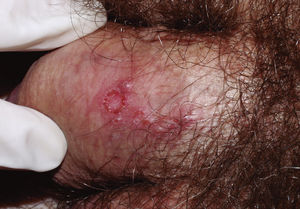
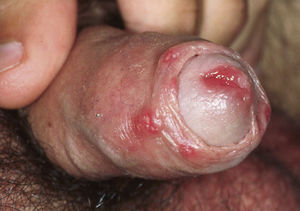
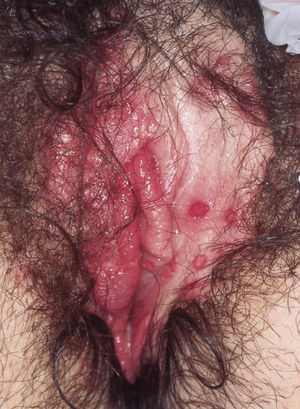
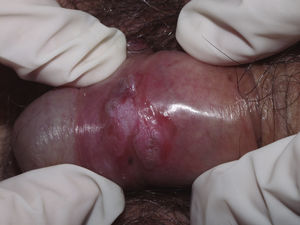
    La causa más frecuente de úlcera genital en el mundo occidental es el virus del herpes simple (VHS).

  • •

    La transmisión se produce por contacto directo mucocutáneo.

  • •

    Las lesiones por VHS son autorresolutivas. En caso de más de 6 recidivas al año, el tratamiento de elección son los antivirales sistémicos a dosis supresivas.

  • •

    El VHS, al producir erosiones y úlceras genitales, predispone especialmente a la adquisición del virus de la inmunodeficiencia humana (VIH).

  • •

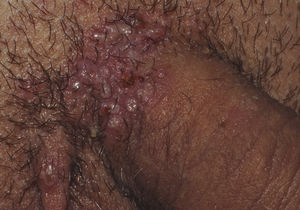
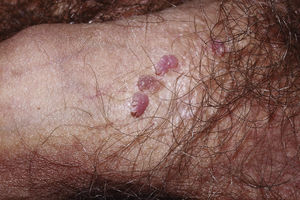
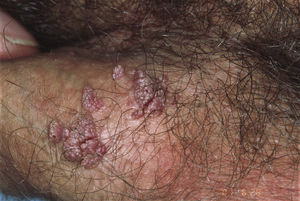
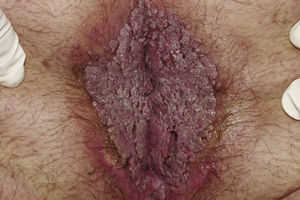
    La infección por virus del papiloma humano (VPH) genital (sobre todo VPH-BR 6 y 11, pero también VPH-AR 16 y 18) es la infección de transmisión sexual más frecuente en el mundo occidental.

  • •

    En casi la totalidad de los cánceres de cérvix se aísla el VPH-AR 16 y 18. En el resto de cánceres de vulva y vagina también están implicados los VPH, sobre todo en pacientes jóvenes (<50 años), aunque con menor frecuencia que el de cérvix.

  • •

    El uso de las vacunas para VPH ha supuesto un gran avance en la prevención de estas lesiones.

  • •

    El tratamiento del VPH y sus complicaciones debe ser individualizado.

  • •

    En los países donde se viene utilizando desde hace 10 años, se ha comprobado que la vacuna reduce las tasas de condilomas en alrededor de un 50% y se espera que también reduzca en un porcentaje similar el carcinoma anogenital.

  • •

    Los virus de la hepatitis B (VHB) y de la hepatitis C (VHC) se pueden adquirir por transmisión sexual, lo que debe advertirse al paciente. Ante un paciente con una ITS hemos de solicitar siempre serologías de lúes, VHB, HVC y VIH.

Palabras clave
Herpes
Papilomavirus
Verrugas
Molluscum
Hepatitis

Identifíquese

¿Aún no es suscriptor de la revista?
Comprar el acceso al artículo

Comprando el artículo el pdf del mismo podrá ser descargado

Teléfono para incidencias

De lunes a viernes de 9h a 18h (GMT+1) excepto los meses de julio y agosto que será de 9 a 15h
Llamadas desde España 932 415 960
Llamadas desde fuera de España +34 932 415 960
Bibliografía
[1]
M.J. Groves.
Genital Herpes: A Review.
Am Fam Physician., (2016), 93 pp. 928-934
[2]
K. Hu, S. He, J. Xiao, M. Li, S. Luo, M. Zhang, et al.
Interaction between herpesvirus entry mediator and HSV-2 glycoproteins mediates HIV-1 entry of HSV-2-infected epithelial cells.
J Gen Virol., (2017), 98 pp. 2351-2361
[3]
V. Martinez, E. Caumes, O. Chosidow.
Treatment to prevent recurrent genital herpes.
Curr Opin Infect Dis., (2008), 21 pp. 42-48
[4]
B. Milpied, M. Janier, J. Timsit, N. Spenatto, E. Caumes, O. Chosidow, et al.
Groupe infectiologie dermatologique et infections sexuellement transmissibles (GrIDIST) de la Société française de dermatologie et du Collège national des gynécologues obstétriciens français (CNGOF). Recommandations diagnostiques et therapeutiques pour les maladies sexuellement transmissibles: herpes genital.
Ann Dermatol Venereol., (2018),
[5]
M.V. Sénat, O. Anselem, O. Picone, L. Renesme, N. Sananès, C. Vauloup-Fellous, et al.
Prevention and management of genital herpes simplex infection during pregnancy and delivery: Guidelines from the French College of Gynaecologists and Obstetricians (CNGOF).
Eur J Obstet Gynecol Reprod Biol., (2018), 224 pp. 93-101
[6]
A.L. Ribeiro, A.S. Caodaglio, L. Sichero.
Regulation of HPV transcription.
Clinics (Sao Paulo)., (2018), 73 pp. e486s
[7]
E. Lazcano-Ponce, S.L. Sudenga, B.N. Torres, M. Stoler, L. León-Maldonado, B. Allen-Leigh, et al.
Incidence of external genital lesions related to human papillomavirus among Mexican men. A cohort study.
Salud Publica Mex., (2018), 60 pp. 633-664
[8]
I.U. Park, C. Introcaso, E.F. Dunne.
Human Papillomavirus and Genital Warts: A Review of the Evidence for the 2015 Centers for Disease Control and Prevention Sexually Transmitted Diseases Treatment Guidelines.
Clin Infect Dis., (2015), 61 pp. S849-S855
[9]
S.M. Garland, E.A. Joura, K.A. Ault, F.X. Bosch, D.R. Brown, X. Castellsagué, et al.
Human Papillomavirus Genotypes From Vaginal and Vulvar Intraepithelial Neoplasia in Females 15-26 Years of Age.
Obstet Gynecol., (2018), 132 pp. 261-270
[10]
K. Murao, R. Yoshioka, Y. Kubo.
Human papillomavirus infection in Bowen disease: negative p53 expression, not p16(INK4a) overexpression, is correlated with human papillomavirus-associated Bowen disease.
J Dermatol., (2014), 41 pp. 878-888
[11]
J.M. Casanova-Seuma, M.R. Garcia de la Fuente, J.M. Fernández-Armenteros, R. Aguayo-Ortiz, V. Sanmartín-Novell.
Lesiones genitales premalignas y malignas.
FMC., (2018), 25 pp. 270-280
[12]
U. Wieland, A. Kreuter.
Kondylome bei HIV-Infizierten.
Hautarzt., (2017), 68 pp. 192-198
[13]
T. Kobayashi, K. Sigel, T. Kalir, I.J. MacLeod, Y. Liu, M. Gaisa.
Anal Cancer Precursor Lesions in HIV-Infected Persons: Tissue Human Papillomavirus Type Distribution and Impact on Treatment Response.
[14]
C.C. Lin, M.C. Hsieh, H.C. Hung, S.M. Tsao, S.C. Chen, H.J. Yang, et al.
Human papillomavirus prevalence and behavioral risk factors among HIV-infected and HIV-uninfected men who have sex with men in Taiwan.
Medicine (Baltimore)., (2018), 97 pp. e13201
[15]
D. Grace, M. Gaspar, R. Paquette, R. Rosenes, A.N. Burchell, T. Grennan, et al.
HIV-positive gay men's knowledge and perceptions of Human Papillomavirus (HPV) and HPV vaccination: A qualitative study.
PLoS One., (2018), 13 pp. e0207953
[16]
J.M. Casanova-Seuma, J.M. Fernández-Armenteros, M.R. García-de la Fuente, M. Llarden García, M. Aguayo-Ortiz.
Tratamiento de las verrugas vulgares y de los condilomas acuminados.
FMC., (2017), 24 pp. 405-413
[17]
H.W. Buck Jr..
Warts. (genital).
BMJ Clin Evid. 2010, (2010),
[18]
E. Tamer, S.K. Çakmak, M.N. İlhan, F. Artüz.
Demographic characteristics and risk factors in Turkish patients with anogenital warts.
J Infect Public Health., (2016), 9 pp. 661-666
[19]
C.F. Grillo-Ardila, E. Angel-Müller, L.C. Salazar-Díaz, H.G. Gaitán, A.I. Ruiz- Parra, A. Lethaby.
Imiquimod for anogenital warts in non-immunocompromised adults.
Cochrane Database Syst Rev., (2014), pp. CD010389
[20]
K.M. Gardner, R.I. Crawford.
Distinction of Condylomata Acuminata from Vulvar Vestibular Papules or Pearly Penile Papules Using Ki-67 Immunostaining.
J Cutan Med Surg., (2018),
[21]
J.B. Karnes, R.P. Usatine.
Management of external genital warts.
Am Fam Physician., (2014), 90 pp. 312-318
[22]
L. Hauk.
CDC Releases 2015 Guidelines on the Treatment of Sexually Transmitted Disease.
Am Fam Physician., (2016), 93 pp. 144-154
[23]
E. Thurgar, S. Barton, C. Karner, S.J. Edwards.
Clinical effectiveness and cost-effectiveness of interventions for the treatment of anogenital warts: systematic review and economic evaluation.
Health Technol Assess., (2016), 20 pp. 1-486
[24]
Z.M. Taner, C. Taskiran, A.M. Onan, R. Gursoy, O. Himmetoglu.
Therapeutic value of trichloroacetic acid in the treatment of isolated genital warts on the external female genitalia.
J Reprod Med., (2007), 52 pp. 521-525
[25]
Anogenital warts.
En: Sexually transmited diseases treatment guidelines.
MMWR., (2015), 64 pp. 86-93
[26]
Human papillomavirus vaccines: WHO position paper, October 2014- Recommendations. Vaccine. 2015;33:4383-4.
[27]
M. Stanley.
HPV vaccination in boys and men.
Hum Vaccin Immunother., (2014), 10 pp. 2109-2111
[28]
A. Gameiro, J. Alves, I. Santo, J. Azevedo.
Condilomas Anogenitais numa Consulta de Doenças Sexualmente Transmissíveis: Centro de Saúde da Lapa - Lisboa, 2008 a 2014.
Acta Med Port., (2016), 29 pp. 101-106
[29]
L.M. Mann, E. Llata, E.W. Flagg, J. Hong, L. Asbel, J. Carlos-Henderson, et al.
Trends of Anogenital Warts Among Sexually Transmitted Disease Clinic Patients -Sexually Transmitted Disease Surveillance Network, United States, 2010-2016.
[30]
M. Steben, M. Tan Thompson, C. Rodier, N. Mallette, V. Racovitan, F. DeAngelis, et al.
A Review of the Impact and Effectiveness of the Quadrivalent Human Papillomavirus Vaccine: 10 Years of Clinical Experience in Canada.
J Obstet Gynaecol Can., (2018), 40 pp. 1635-1645
[31]
C. Rossi, C. Vanhomwegen, F. Laurent.
Vaccination contre le papillomavirus humain (HPV) chez les garçons et les hommes: actualités et recommandations.
Rev Med Brux., (2018), 39 pp. 352-358
[32]
L. Zichichi, M. Maniscalco.
The challenges of a neglected STI: Molluscum contagiosum.
G Ital Dermatol Venereol., (2012), 147 pp. 447-453