

Vol. 31. Núm. 9.
Páginas 461-468 (Noviembre 2024)

Uso adecuado de exploraciones complementarias
Los métodos de diagnóstico rápido de las ITS exudativas

David Palma DíazabcdMaider Arando LasagabastereCarles Pericas EscalebfgCristina Rius i Gilbertabgh
Doi : https://10.1016/j.fmc.2024.01.009
Opciones
Puntos para una lectura rápida

  • •

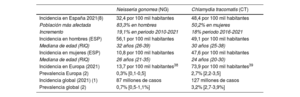
    Las infecciones por gonococo son un problema creciente en población sexualmente activa con diversas parejas sexuales, especialmente en colectivos expuestos a vulnerabilidades sistémicas que incrementan su riesgo epidemiológico.

  • •

    Frente a un síndrome exudativo es necesario pensar en otras ITS además de la gonorrea, desde una perspectiva de salud sexual, considerando las poblaciones claves y los contextos epidemiológicos.

  • •

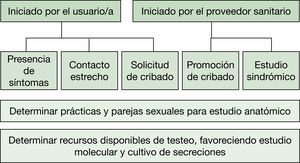
    Las uretritis pueden transmitirse por contacto de diversas mucosas involucradas en el sexo, por lo que el estudio debe realizarse según las prácticas de los usuarios, recogidos durante la anamnesis.

  • •

    En los servicios de atención primaria españoles es posible favorecer siempre el estudio por PCR antes que el manejo sindrómico, añadiendo cultivo para estudio de resistencia, notificación obligatoria del caso y estudio de contactos a cargo de quien diagnostica.

  • •

    Existen test de diagnóstico rápido de gonococo, en su mayoría basados en PCR en tiempo real, que permiten desarrollar estrategias sanitarias de mayor costo efectividad, realizando el proceso completo de atención en un mismo momento, y cuya implementación depende de acciones políticas territoriales.

  • •

    A nivel territorial, los profesionales sanitarios deben reconocer las redes de servicios sanitarios, comunitarios y privados vinculados al continuo de cuidados de las ITS, favoreciendo una detección temprana y una respuesta fortalecida e integrada a las necesidades de salud sexual.

Palabras clave
Infecciones de transmisión sexual
Uretritis
Neisseria gonorrhoeae
Point of care
Salud sexual
Poblaciones claves

Identifíquese

¿Aún no es suscriptor de la revista?
Comprar el acceso al artículo

Comprando el artículo el pdf del mismo podrá ser descargado

Teléfono para incidencias

De lunes a viernes de 9h a 18h (GMT+1) excepto los meses de julio y agosto que será de 9 a 15h
Llamadas desde España 932 415 960
Llamadas desde fuera de España +34 932 415 960
Bibliografía
[1]
World Health Organization. Global progress report on HIV, viral hepatitis and sexually transmitted infections, 2021 [Internet]. Geneva; 2021 [citado 18 Nov 2023]. Disponible en:: https://www.who.int/publications/i/item/9789240027077.
[2]
O. Mitjà, V. Padovese, C. Folch, I. Rossoni, M. Marks, M.A. Rodríguez i Arias, et al.
Epidemiology and determinants of reemerging bacterial sexually transmitted infections (STIs) and emerging STIs in Europe.
The Lancet Regional Health - Europe., (2023), 34 pp. 100742
[3]
B. Van Der Pol, C.A. Gaydos.
A profile of the binx health io ® molecular point-of-care test for chlamydia and gonorrhea in women and men.
Expert Rev Mol Diagn., (2021), 21 pp. 861-868
[4]
J. Del Romero, S. Moreno Guillén, F. Rodríguez-Artalejo, J. Ruiz-Galiana, R. Cantón, P. de Lucas Ramos, et al.
Sexually transmitted infections in Spain: Current status.
Revista Española de Quimioterapia., (2023), 36 pp. 444-465
[5]
Ministerio de Sanidad. Plan Estratégico para la Prevención y Control de la Infección por el VIH y las ITS en España. Madrid; 2023.
[6]
Agencia Española de Medicamentos y Productos Sanitarios (AEMPS). Plan estratégico 2022-2024 del Plan nacional frente a la resistencia a los antibióticos (PRAN) [Internet]. Madrid; 2022 Sep [citado 18 Nov 2023]. Disponible en: https://www.resistenciaantibioticos.es/sites/default/files/2022-09/Plan%20Nacional%20Resistencia%20Antibióticos%20%28PRAN%29%202022-2024.pdf.
[7]
S.L. Chung, N.S. Wong, K.M. Ho, S.S. Lee.
Coinfection and repeat bacterial sexually transmitted infections (STI) – retrospective study on male attendees of public STI clinics in an Asia Pacific city.
Epidemiol Infect., (2023), 151 pp. e101
[8]
Unidad de vigilancia de VIH I y hepatitis B y C. Vigilancia epidemiológica de las infecciones de transmisión sexual, 2021. Madrid; 2023.
[9]
M. Kahn, B. Van Der Pol.
Advances in Diagnostics of Sexually Transmitted Infections.
Infect Dis Clin North Am., (2023), 37 pp. 381-403
[10]
World Health Organization. Guidelines for the management of symptomatic sexually transmitted infections. Geneva; 2021.
[11]
R. Kularatne, V. Maseko, P. Mahlangu, E. Muller, T. Kufa.
Etiological Surveillance of Male Urethritis Syndrome in South Africa: 2019 to 2020.
Sex Transm Dis., (2022), 49 pp. 560-564
[12]
B. Sadoghi, B. Kränke, P. Komericki, G. Hutterer.
Sexually transmitted pathogens causing urethritis: A mini-review and proposal of a clinically based diagnostic and therapeutic algorithm.
Front Med (Lausanne)., (2022), 9
[13]
K.A. Workowski, L.H. Bachmann, P.A. Chan, C.M. Johnston, C.A. Muzny, I. Park, et al.
Sexually Transmitted Infections Treatment Guidelines, 2021.
MMWR Recommendations and Reports., (2021), 70 pp. 1-187
[14]
L.A. Barbee, S.B. St. Cyr.
Management of Neisseria gonorrhoeae in the United States: Summary of Evidence From the Development of the 2020 Gonorrhea Treatment Recommendations and the 2021 Centers for Disease Control and Prevention Sexually Transmitted Infection Treatment Guidelines.
Clinical Infectious Diseases., (2022), 74 pp. S95-S111
[15]
K.M. Fisk, A. Derouin, G. Holm, L. Hicks.
Getting it Right: The Impact of Point-of-Care Testing for Gonorrhea and Chlamydia in the Urgent Care Setting.
J Nurse Pract., (2020), 16 pp. 388-393
[16]
J.J. Ong, C. Bourne, J.A. Dean, N. Ryder, V.J. Cornelisse, S. Murray, et al.
Australian sexually transmitted infection (STI) management guidelines for use in primary care 2022 update.
Sex Health., (2022), 20 pp. 1-8
[17]
K. Phyu, H. Curtis, H. Wallace, L. Goodall, V. Apea, H. Iveson.
2020 BASHH national clinical audit: Management of infection with Neisseria gonorrhoeae.
Int J STD AIDS., (2023), 34 pp. 203-207
[18]
E. Hansman, J.D. Klausner.
Approach to Managing Sex Partners of People with Sexually Transmitted Infections.
Infect Dis Clin North Am., (2023 Jun), 37 pp. 405-426
[19]
Grupo de Expertos del Grupo de estudio de SIDA de la SEIMC (GESIDA), Secretaria del Plan Nacional sobre el SIDA (SPNS), Grupo de estudio de ITS de la SEIMC (GEITS), Grupo Español para la Investigación de las Enfermedades de Transmisión Sexual de la Academia Española de Dermatología y Venerología, sociedad española de infectología pediátrica (SEIP). Documento de consenso sobre diagnóstico y tratamiento de las infecciones de transmisión sexual en adultos, niños y adolescentes (actualización marzo 2017). Madrid; 2017.
[20]
T.E. Wi, F.J. Ndowa, C. Ferreyra, C. Kelly-Cirino, M.M. Taylor, I. Toskin, et al.
Diagnosing sexually transmitted infections in resource-constrained settings: challenges and ways forward.
J Int AIDS Soc., (2019), 22
[21]
B. Van Der Pol, S.N. Taylor, L. Mena, J. Lebed, C.J. McNeil, L. Crane, et al.
Evaluation of the Performance of a Point-of-Care Test for Chlamydia and Gonorrhea.
JAMA Netw Open, (2020), 3 pp. e204819
[22]
M. Besa Castellà, C. Agustí Benito, C. Roca Saumell, J.J. Mascort Roca.
Manejo en atención primaria de las infecciones de transmisión sexual (I). Epidemiología. Síndrome secretor.
Aten Primaria., (2023), 55 pp. 102597
[23]
División de control de VIH IH virales y Tuberculosis. Red de Programas Comunitarios de Cribado de VIH (RedCoVIH). Informe preliminar enero-octubre 2021. D.G. de Salud Pública. Madrid; 2021 Nov.
[24]
D. Gökengin, T. Noori, A. Alemany, C. Bienkowski, G. Liegon, Ankaya AÇ, et al.
Prevention strategies for sexually transmitted infections, HIV, and viral hepatitis in Europe.
The Lancet Regional Health - Europe, (2023 Nov), 34 pp. 100738
[25]
C. Thng, E.A. Semchenko, I. Hughes, M. O'Sullivan, K.L. Seib.
An open-label randomised controlled trial evaluating the efficacy of a meningococcal serogroup B (4CMenB) vaccine on Neisseria gonorrhoeae infection in gay and bisexual men: the MenGO study protocol.
BMC Public Health, (2023), 23 pp. 607
[26]
D. Hornuss, P. Mathé, S. Usadel, S. Zimmermann, M. Müller, S. Rieg.
Already current practice? A snapshot survey on doxycycline use for prevention of sexually transmitted infections in parts of the German MSM community.
Infection., (2023), 51 pp. 1831-1834
[27]
C. Kenyon, Z. Gestels, T. Vanbaelen, S. Abdellati, D. Van Den Bossche, I. De Baetselier, et al.
Doxycycline PEP can induce doxycycline resistance in Klebsiella pneumoniae in a Galleria mellonella model of PEP.
Front Microbiol., (2023), 14
[28]
P.C. Adamson, M.J. Loeffelholz, J.D. Klausner.
Point-of-Care Testing for Sexually Transmitted Infections: A Review of Recent Developments.
Arch Pathol Lab Med., (2020), 144 pp. 1344-1351
[29]
K. Martin, R. Wenlock, T. Roper, C. Butler, J.H. Vera.
Facilitators and barriers to point-of-care testing for sexually transmitted infections in low- and middle-income countries: a scoping review.
BMC Infect Dis., (2022), 22 pp. 561
[30]
M. Unemo, M.M. Lahra, M. Escher, S. Eremin, M.J. Cole, P. Galarza, et al.
WHO global antimicrobial resistance surveillance for Neisseria gonorrhoeae 2017-18: a retrospective observational study.
Lancet Microbe., (2021), 2 pp. e627-e636
[31]
M.F. Pontes, G. Armington, R. Fink, C.A. Gaydos, Y.C. Manabe.
Landscape Review of Mail-in Self-Collection. Programs for Sexually Transmitted Infections.
Sex Transm Dis., (2023), 50 pp. 336-341
[32]
C. Agustí.
TESTATE: Oferta on-line de kits de auto-recogida de muestras para la detección de VIH e ITS dirigida a gays, bisexuales y otros hombres que tienen sexo con hombres y mujeres trans.
Revista de Enfermedades Emergentes., (2022), 20 pp. 92-94
[33]
S.S. Fuller, E. Clarke, E.M. Harding-Esch.
Molecular chlamydia and gonorrhoea point of care tests implemented into routine practice: Systematic review and value proposition development.
PLoS One., (2021 Nov 8), 16 pp. e0259593
[34]
A. Pacho, E.M. Harding-Esch, E.G. Heming De-Allie, L. Phillips, M. Furegato, S.T. Sadiq, et al.
Facilitators and barriers for clinical implementation of a 30-minute point-of-care test for Neisseria gonorrhoeae and Chlamydia trachomatis into clinical care: A qualitative study within sexual health services in England.
PLoS One., (2022), 17 pp. e0265173
[35]
P. Mulgund, R. Sharman, S. Purao, S.S. Thimmanayakanapalya, P. Winkelstein.
Mapping Information Needs of Patients With Sexually Transmitted Infections Using Web-Based Data Sources: Grounded Theory Investigation.
J Med Internet Res., (2021), 23 pp. e30125
[36]
B. Van Der Pol, C.A. Gaydos.
A profile of the binx health io ® molecular point-of-care test for chlamydia and gonorrhea in women and men.
Expert Rev Mol Diagn., (2021), 21 pp. 861-868
[37]
J. Gómez Castellá, A. Díaz Franco, R. Polo Rodríguez, J. del Amo Valero.
Approaches to STI Prevention and Control in a Highly Decentralized State: An Integrative Review.
Frontiers in Reproductive Health, (2022), 4
[38]
European Centre for Disease Prevention and Control. Gonorrhoea. En: ECDC. Annual epidemiological report for 2021. Stockholm; 2023.
[39]
European Centre for Disease Prevention and ControlChlamydia. Chlamydia. En: ECDC. Annual epidemiological report for 2021. Stockholm; 2023.
[40]
G.E. Wood, C.S. Bradshaw, L.E. Manhart.
Update in Epidemiology and Management of Mycoplasma genitalium Infections.
Infect Dis Clin North Am., (2023), 37 pp. 311-333
[41]
P. Idigoras, M. Montes, M. López-Olaizola, I. de la Caba, D. Grandioso, G. Cilla.
Adenovirus-Associated Urethritis, a Not So Uncommon Entity. A Review of 91 Cases.
Sex Transm Dis., (2023), 50 pp. 770-773
[42]
B. Le Vavasseur, S. Bendaoud, S. Taieb, B. Heym, S.Y. Dahlouk, E. Leclerc, et al.
Anal Monkeypox Disease: Description of 65 Cases.
Dis Colon Rectum., (2023),
[43]
K.A. Zinsli, S. Srinivasan, J.E. Balkus, L.C. Chambers, M.S. Lowens, J. Morgan, et al.
Bacterial vaginosis-associated bacteria in cisgender men who have sex with women: prevalence, association with non-gonococcal urethritis and natural history.
Sex Transm Infect., (2022),
[44]
C.A. Gaydos, C.P. Cartwright, P. Colaninno, J. Welsch, J. Holden, S.Y. Ho, et al.
Performance of the Abbott RealTi m e CT/NG for Detection of Chlamydia trachomatis and Neisseria gonorrhoeae.
J Clin Microbiol., (2010), 48 pp. 3236-3243
[45]
C. Matysiak, A. Cheng, J.E. Kirby.
Evaluation of the Abbott Alinity m STI assay for diagnosis of the primary causes of sexually transmitted infections in the United States.
Pract Lab Med., (2023), 36 pp. e00332
[46]
C.A. Gaydos, T.C. Quinn, D. Willis, A. Weissfeld, E.W. Hook, D.H. Martin, et al.
Performance of the APTIMA Combo 2 Assay for Detection of Chlamydia trachomatis and Neisseria gonorrhoeae in Female Urine and Endocervical Swab Specimens.
J Clin Microbiol., (2003), 41 pp. 304-309
[47]
B. Van Der Pol, K. Fife, S.N. Taylor, M.B. Nye, S.E. Chavoustie, D.L. Eisenberg, et al.
Evaluation of the Performance of the Cobas CT/NG Test for Use on the Cobas 6800/8800 Systems for Detection of Chlamydia trachomatis and Neisseria gonorrhoeae in Male and Female Urogenital Samples.
J Clin Microbiol., (2019), 57
[48]
D.J. Shin, P. Athamanolap, L. Chen, J. Hardick, M. Lewis, Y.H. Hsieh, et al.
Mobile nucleic acid amplification testing (mobiNAAT) for Chlamydia trachomatis screening in hospital emergency department settings.
[49]
E.M. Harding-Esch, S.S. Fuller, S.L.C. Chow, A.V. Nori, M.A. Harrison, M. Parker, et al.
Diagnostic accuracy of a prototype rapid chlamydia and gonorrhoea recombinase polymerase amplification assay: a multicentre cross-sectional preclinical evaluation.
Clinical Microbiology and Infection., (2019), 25
[50]
S.R. Morris, C.C. Bristow, M.R. Wierzbicki, M. Sarno, L. Asbel, A. French, et al.
Performance of a single-use, rapid, point-of-care PCR device for the detection of Neisseria gonorrhoeae, Chlamydia trachomatis, and Trichomonas vaginalis: a cross-sectional study.
Lancet Infect Dis., (2021), 21 pp. 668-676
[51]
T.A. Xie, Y.L. Liu, R.C. Meng, X.S. Liu, K.Y. Fang, S.T. Deng, et al.
Evaluation of the Diagnostic Efficacy of Xpert CT/NG for Chlamydia trachomatis and Neisseria gonorrhoeae.
Biomed Res Int., (2020), 2020 pp. 1-16