



Vol. 31. Núm. 2.
Páginas 72-78 (Febrero 2024)

Actualizando la práctica asistencial
Riesgo cardiovascular: valoración y criterios de abordaje

Rafel Ramos BlanesPascual Solanas Saura
Doi : https://10.1016/j.fmc.2023.10.003
Opciones
Puntos para una lectura rápida

  • •

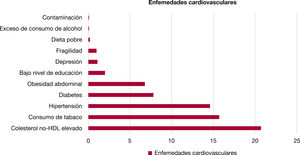
    Las intervenciones de reducción de riesgo son más eficientes cuando se realizan en la población de riesgo elevado. Es por ello que la identificación de estos individuos mediante el uso de funciones de riesgo es un elemento fundamental.

  • •

    Las ecuaciones de riesgo estiman el exceso de riesgo de tener una enfermedad cardiovascular en un periodo de tiempo que tiene un individuo concreto en relación con el riesgo promedio de la población.

  • •

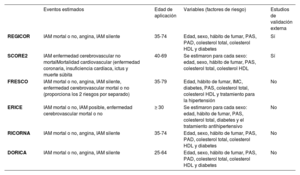
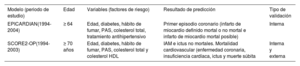
    La ecuación de REGICOR y la de SCORE2 son las más recomendadas y utilizadas. Ambas tienen estudios de validación.

  • •

    Aparte de los factores de riesgo incluidos en las ecuaciones, existen otros que pueden modificar el riesgo calculado. La consideración de estos factores es particularmente relevante si el riesgo del individuo está cerca de un umbral de decisión.

  • •

    El riesgo elevado se define como la probabilidad igual o superior al 10% según REGICOR o en función de la edad según SCORE2 (2,5% en menores de 50 años; 5% en 50-69 años; 7,5% en mayores de 69 años).

  • •

    A partir de estas clasificaciones, las intervenciones clínicas aconsejadas que se derivan varían considerablemente en función de la Guía de Práctica Clínica. En general, en las personas con riesgos bajos o intermedios, la promoción de los estilos de vida saludables es la intervención aconsejada. En las personas con riesgo alto se debe considerar añadir tratamiento farmacológico, especialmente hipolipemiante. En las personas con riesgo muy alto, el tratamiento debe ser más intensivo.

Palabras clave
Prevención cardiovascular
Factores de riesgo cardiovascular
Ecuaciones de riesgo cardiovascular
Factores modificadores del riesgo

Identifíquese

¿Aún no es suscriptor de la revista?
Comprar el acceso al artículo

Comprando el artículo el pdf del mismo podrá ser descargado

Teléfono para incidencias

De lunes a viernes de 9h a 18h (GMT+1) excepto los meses de julio y agosto que será de 9 a 15h
Llamadas desde España 932 415 960
Llamadas desde fuera de España +34 932 415 960
Bibliografía
[1]
G.A. Roth, G.A. Mensah, C.O. Johnson, G. Addolorato, E. Ammirati, L.M. Baddour, et al.
Global Burden of Cardiovascular Diseases and Risk Factors, 1990-2019: Update From the GBD 2019 Study.
J Am Coll Cardiol., (2020), 76 pp. 2982-3021
[2]
Ministerio de Sanidad SS e I. Indicadores de Salud 2020 Evolución de los indicadores del estado de salud en España y su magnitud en el contexto de la Unión Europea. Madrid; 2020. Disponible en: https://www.mscbs.gob.es/estadEstudios/estadisticas/inforRecopilaciones/docs/Indicadores_de_Salud_2020.pdf.
[3]
Institute for Health Metrics and Evaluation. Global Burden of Disease Results Tool, Global Health Data Exchange [Internet]. 2017. Disponible en: http://ghdx.healthdata.org/gbd-results-tool.
[4]
J.B. Soriano, D. Rojas-Rueda, J. Alonso, J.M. Antó, P.J. Cardona, E. Fernández, et al.
Colaboradores de GBD en España; Lista de colaboradores de GBD en España. The burden of disease in Spain: Results from the Global Burden of Disease 2016.
Med Clin (Barc)., (2018), 151 pp. 171-190
[5]
S. Yusuf, P. Joseph, S. Rangarajan, S. Islam, A. Mente, P. Hystad, et al.
Modifiable risk factors, cardiovascular disease, and mortality in 155 722 individuals from 21 high-income, middle-income, and low-income countries (PURE): a prospective cohort study.
Lancet., (2020), 395 pp. 795-808
[6]
Cholesterol Treatment Trialists’ (CTT) Collaborators, B. Mihaylova, J. Emberson, L. Blackwell, A. Keech, J. Simes, et al.
The effects of lowering LDL cholesterol with statin therapy in people at low risk of vascular disease: meta-analysis of individual data from 27 randomised trials.
Lancet., (2012), 380 pp. 581-590
[7]
F.L.J. Visseren, F. Mach, Y.M. Smulders, D. Carballo, K.C. Koskinas, M. Bäck, et al.
ESC Scientific Document Group. 2021 ESC Guidelines on cardiovascular disease prevention in clinical practice.
Eur J Prev Cardiol., (2022), 29 pp. 5-115
[8]
D.K. Arnett, R.S. Blumenthal, M.A. Albert, A.B. Buroker, Z.D. Goldberger, E.J. Hahn, et al.
2019 ACC/AHA Guideline on the Primary Prevention of Cardiovascular Disease: Executive Summary: A Report of the American College of Cardiology/American Heart Association Task Force on Clinical Practice Guidelines.
J Am Coll Cardiol., (2019), 74 pp. 1376-1414
[9]
National Institute for Health and Care Excellence. Lipid modification: cardiovascular risk assessment and the modification of blood lipids for the primary and secondary prevention of cardiovascular disease. 9 March 2016. Disponible en: http://guidance.nice.org.uk/cg181.
[10]
R. Elosua.
Cardiovascular risk functions: usefulness and limitations.
Rev Esp Cardiol (Engl Ed)., (2014), 67 pp. 77-79
[11]
J. Marrugat, R. D’Agostino, L. Sullivan, R. Elosua, P. Wilson, J. Ordovas, et al.
An adaptation of the Framingham coronary heart disease risk function to European Mediterranean areas.
J Epidemiol Community Health., (2003), 57 pp. 634-638
[12]
SCORE2 working group and ESC Cardiovascular risk collaboration.
SCORE2 risk prediction algorithms: new models to estimate 10-year risk of cardiovascular disease in Europe.
Eur Heart J., (2021), 42 pp. 2439-2454
[13]
J. Aranceta, C. Pérez Rodrigo, M. Foz Sala, T. Mantilla, L. Serra Majem, B. Moreno, et al.
Grupo Colaborativo para el estudio DORICA fase 2. [Tables of coronary risk evaluation adapted to the Spanish population: the DORICA study].
Med Clin (Barc)., (2004), 123 pp. 686-691
[14]
P. González-Diego, C. Moreno-Iribas, M.J. Guembe, J.J. Viñes, J. Vila.
Adaptation of the Framingham-Wilson coronary risk equation for the population of Navarra (RICORNA).
Rev Esp Cardiol., (2009), 62 pp. 875-885
[15]
J. Marrugat, I. Subirana, R. Ramos, J. Vila, A. Marín-Ibañez, M.J. Guembe, et al.
Derivation and validation of a set of 10-year cardiovascular risk predictive functions in Spain: the FRESCO Study.
Prev Med., (2014), 61 pp. 66-74
[16]
R. Gabriel, C. Brotons, M.J. Tormo, A. Segura, F. Rigo, R. Elosua, et al.
The ERICE-score: the new native cardiovascular score for the low-risk and aged Mediterranean population of Spain.
Rev Esp Cardiol., (2015), 68 pp. 205-215
[17]
P. Armario, C. Brotons, R. Elosua, M. Alonso de Leciñana, A. Castro, A. Clarà, et al.
Statement of the Spanish Interdisciplinary Vascular Prevention Committee on the updated European Cardiovascular Prevention Guidelines.
Clin Investig Arterioscler., (2021), 33 pp. 85-107
[18]
R. Gabriel, J. Muñiz, S. Vega, I. Moral, T.R. Pérez Castro, F. Rodriguez-Salvanés, et al.
Cardiovascular risk in the elderly population of Spain. The EPICARDIAN risk score.
Rev Clin Esp [Internet], (2022), 222 pp. 13-21
[19]
CORE2-OP working group and ESC Cardiovascular risk collaboration.
SCORE2-OP risk prediction algorithms: Estimating incident cardiovascular event risk in older persons in four geographical risk regions.
Eur Heart J., (2021), 42 pp. 2455-2467
[20]
R.B. D’Agostino, S. Grundy, L.M. Sullivan, P. Wilson, CHD Risk Prediction Group.
Validation of the Framingham coronary heart disease prediction scores: results of a multiple ethnic groups investigation.
JAMA., (2001), 286 pp. 180-187
[21]
J. Yeboah, R.L. McClelland, T.S. Polonsky, G.L. Burke, C.T. Sibley, D. O’Leary, et al.
Comparison of novel risk markers for improvement in cardiovascular risk assessment in intermediate-risk individuals.
JAMA., (2012), 308 pp. 788-795
[22]
V. Aboyans, J.B. Ricco, M.E.L. Bartelink, M. Björck, M. Brodmann, T. Cohnert, et al.
ESC Scientific Document Group. 2017 ESC Guidelines on the Diagnosis and Treatment of Peripheral Arterial Diseases, in collaboration with the European Society for Vascular Surgery (ESVS): Document covering atherosclerotic disease of extracranial carotid and vertebral, mesenteric, renal, upper and lower extremity arteries Endorsed by: the European Stroke Organization (ESO)The Task Force for the Diagnosis and Treatment of Peripheral Arterial Diseases of the European Society of Cardiology (ESC) and of the European Society for Vascular Surgery (ESVS).
Eur Heart J., (2018), 39 pp. 763-816
[23]
R. Ramos, M. Quesada, P. Solanas, I. Subirana, J. Sala, J. Vila, et al.
REGICOR Investigators. Prevalence of symptomatic and asymptomatic peripheral arterial disease and the value of the ankle-brachial index to stratify cardiovascular risk.
Eur J Vasc Endovasc Surg., (2009), 38 pp. 305-311
[24]
M.T. Alzamora, R. Forés, J.M. Baena-Díez, G. Pera, P. Toran, M. Sorribes, et al.
PERART/ARTPER study group. The peripheral arterial disease study (PERART/ARTPER): prevalence and risk factors in the general population.
BMC Public Health., (2010), 10 pp. 38
[25]
M.T. Alzamora, R. Forés, G. Pera, P. Torán, A. Heras, M. Sorribes, et al.
Ankle-brachial index and the incidence of cardiovascular events in the Mediterranean low cardiovascular risk population ARTPER cohort.
BMC Cardiovasc Disord., (2013), 13 pp. 119
[26]
Ankle Brachial Index Collaboration.
Ankle brachial index combined with Framingham risk score to predict cardiovascular events and mortality. A meta-analysis.
JAMA., (2008), 300 pp. 197-208
[27]
A. Velescu, A. Clara, J. Peñafiel, R. Ramos, R. Marti, M. Grau, et al.
REGICOR Study Group. Adding low ankle brachial index to classical risk factors improves the prediction of major cardiovascular events. The REGICOR study.
Atherosclerosis., (2015), 241 pp. 357-363
[28]
R. Ramos, M. García-Gil, M. Comas-Cufí, M. Quesada, J. Marrugat, R. Elosua, et al.
Statins for Prevention of Cardiovascular Events in a Low-Risk Population With Low Ankle Brachial Index.
J Am Coll Cardiol., (2016), 67 pp. 630-640
[29]
C. Brotons Cuixart, J.J. Alemán Sánchez, J.R. Banegas Banegas, C. Fondón León, J.M. Lobos-Bejarano, E. Martín Rioboó, et al.
Grupo de Prevención Cardiovascular del PAPPS. Recomendaciones preventivas cardiovasculares. Actualización PAPPS 2018.
Aten Primaria., (2018), 50 Suppl 1 pp. 4-28
[30]
C. Brotons, J.M. Lobos, M.A. Royo-Bordonada, A. Maiques, A. De Santiago, A. Castellanos, et al.
Implementation of Spanish adaptation of the European guidelines on cardiovascular disease prevention in primary care.
BMC Fam Pract., (2013), 14 pp. 36