



Vol. 31. Núm. 2.
Páginas 101-109 (Febrero 2024)

Terapéutica en APS
Sequedad vaginal

José Luis Gallo Vallejoab
Doi : https://10.1016/j.fmc.2023.07.006
Opciones
Puntos para una lectura rápida

  • •

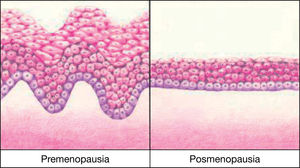
    En España, en las mujeres posmenopáusicas y en lo referente al SGM, el síntoma más frecuente es la sequedad vaginal (81%). Solo un 15% de ellas reciben tratamiento.

  • •

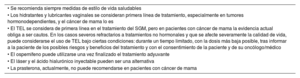
    Los productos OTC (sin prescripción médica), como los hidratantes y lubricantes vaginales, son una opción a tener en cuenta en el tratamiento de la sequedad vaginal, sobre todo cuando los tratamientos hormonales o farmacológicos están contraindicados.

  • •

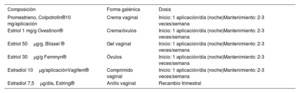
    La terapia con estrógenos locales a dosis bajas como opción terapéutica para la sequedad vaginal presenta un perfil de seguridad más favorable que la terapia hormonal sistémica.

  • •

    El tratamiento hormonal local ideal sería aquel que provea estrógenos, que revierta la atrofia urogenital, que alivie los síntomas y que evada efectos sistémicos.

  • •

    La prasterona es el único tratamiento hormonal efectivo para la sequedad vaginal que ejerce actividad estrogénica y androgénica en todas las capas de la vagina, con un buen perfil de seguridad.

  • •

    Sugerimos ospemifeno en lugar de estrógenos vaginales para aquellas pacientes que no pueden usarlos o prefieren no usar un producto vaginal.

  • •

    El ospemifeno es el único tratamiento hormonal que tiene indicación de uso en mujeres con antecedentes de cáncer de mama que han finalizado el tratamiento adyuvante.

  • •

    La aplicación de láser ginecológico mejora la sequedad vaginal y la dispareunia, así como la función sexual y los síntomas urinarios.

Palabras clave
Sequedad vaginal
Tratamiento
Calidad de vida

Identifíquese

¿Aún no es suscriptor de la revista?
Comprar el acceso al artículo

Comprando el artículo el pdf del mismo podrá ser descargado

Teléfono para incidencias

De lunes a viernes de 9h a 18h (GMT+1) excepto los meses de julio y agosto que será de 9 a 15h
Llamadas desde España 932 415 960
Llamadas desde fuera de España +34 932 415 960
Bibliografía
[1]
D.J. Portman, M.L.S. Gass.
Vulvovaginal Atrophy Terminology Consensus Conference Panel. Genitourinary syndrome of menopause: new terminology for vulvovaginal atrophy from the International Society for the Study of Women's Sexual Health and the North American Menopause Society.
Menopause., (2014), 21 pp. 1063-1068
[2]
S. Palacios, S.P. González, M. Fernández-Abellán, M. Manubens, P. García-Alfaro, C.A. Prieto, et al.
Impact Of Vulvovaginal Atrophy Of Menopause In Spanish Women: Prevalence And Symptoms According To The EVES Study.
Sexual Medicine., (2019), 7 pp. 207-216
[3]
L. Azcona.
Sequedad vaginal.
Farmacia Profesional., (2007), 21 pp. 56-59
[4]
R.E. Nappi, M. Kokot-Kierepa.
Vaginal Health: Insights, Views & Attitudes (VIVA) – results from an international survey.
Climacteric., (2012), 15 pp. 36-44
[5]
S. Palacios, M.J. Cancelo, C. Castelo Branco, P. Llaneza, F. Molero, R.S. Borrego.
Vulvar and vaginal atrophy as viewed by the Spanish REVIVE participants: symptoms, management and treatment perceptions.
Climacteric., (2017), 20 pp. 55-61
[6]
G.D. Constantine, S. Graham, C. Clerinx, B.A. Bernick, M. Krassan, S. Mirkin, et al.
Behaviours and attitudes influencing treatment decisions for menopausal symptoms in five European countries.
Post Reproductive Health., (2016 23), 22 pp. 112-122
[7]
S.S. Faubion, S.A. Kingsberg, A.L. Clark, A.M. Kaunitz, S.K. Spadt, L.C. Larkin, et al.
The 2020 genitourinary syndrome of menopause position statement of the North American Menopause Society.
Menopause., (2020), 27 pp. 976-992
[8]
Baquedano L, Sánchez S, Aznar T, Cancelo MJ, Escribano JJ, González S, et al. Síndrome genitourinario de la menopausia, MenoGuía AEE. Primera edición 2020.
[9]
P. Stute.
Is vaginal hyaluronic acid as effective as vaginal estriol for vaginal dryness relief?.
Archives of Gynecology and Obstetrics., (2013), 288 pp. 1199-1201
[10]
T. Pérez Medina, C. Vignardi Guerra.
Patología vaginal en la menopausia. Actualizaciones El Médico.
Sanidad y Ediciones S.L. (grupo SANED), (2014),
[11]
R. Sánchez-Borrego, M. Manubens, M.C. Navarro, M.J. Cancelo, E. Beltrán, M. Duran, et al.
Position of the Spanish Menopause Society regarding vaginal health care in postmenopausal women.
Maturitas., (2014), 78 pp. 146-150
[12]
C. Biehl, O. Plotsker, S. Mirkin.
A systematic review of the efficacy and safety of vaginal estrogen products for the treatment of genitourinary syndrome of menopause.
Menopause., (2019), 26 pp. 431-453
[13]
A. Cano, J. Estévez, R. Usandizaga, J.L. Gallo, M. Guinot, J.L. Delgado, et al.
The therapeutic effect of a new ultra low concentration estriol gel formulation (0.005% estriol vaginal gel) on symptoms and signs of postmenopausal vaginal atrophy: results from a pivotal phase III study. Menopause, (2012), 19 pp. 1130-1139
[14]
Management of symptomatic vulvovaginal atrophy: 2013 position statement of the North American Menopause Society. Menopause. 2013;20:888-902.
[15]
N. Mendoza, F. Molero, F. Criado, M.J. Cornellana, E. González.
Sexual health after breast cancer: Recommendations from the Spanish Menopause Society, Federación Española de Sociedades de Sexología, Sociedad Española de Médicos de Atención Primaria and Sociedad Española de Oncología Médica.
Maturitas., (2017), 105 pp. 126-131
[16]
Informe de Posicionamiento Terapéutico de Prasterona (Intrarosa®) en el tratamiento de la atrofia vulvovaginal en mujeres postmenopáusicas con síntomas moderados a graves. 2019. Disponible en: aemps.gob.es/IPT-prasterona-Intrarosa.
[17]
F. Labrie, D.F. Archer, W. Koltun, A. Vachon, D. Young, L. Frenette, et al.
Efficacy of intravaginal dehydroepiandrosterone (DHEA) on moderate to severe dyspareunia and vaginal dryness, symptoms of vulvovaginal atrophy, and of the genitourinary syndrome of menopause.
Menopause., (2016), 25 pp. 1339-1353
[18]
D.J. Portman, S.R. Goldstein, R. Kagan.
Treatment of moderate to severe dyspareunia with intravaginal prasterone therapy: a review.
Climacteric., (2019), 22 pp. 65-72
[19]
C. Castelo Branco.
Prasterona en el tratamiento del síndrome genitourinario de la menopausia.
Clin Invest Gin Obst., (2021), 48 pp. 67
[20]
R.E. Nappi, M. Kokot-Kierepa.
Women's voices in the menopause: Results from an international survey on vaginal atrophy.
Maturitas., (2010), 67 pp. 233-238
[21]
S. Palacios, M.J. Cancelo, C. Castelo-Branco, P. Llaneza, F. Molero, N. Mendoza, et al.
Ospemifeno. MenoGuía AEEM. Primera edición: Abril 2019.
Aureagràfic, s.l, (2019),
[22]
V. Di Donato, M.C. Schiavi, V. Iacobelli, O. D’oria, E. Kontopantelis, T. Simoncini, et al.
Ospemifene for the treatment of vulvar and vaginal atrophy: A meta-analysis of randomized trials. Part II: Evaluation of tolerability and safety.
Maturitas., (2019), 121 pp. 93-100
[23]
B. Cai, J. Simon, P. Villa, N. Biglia, N. Panay, S. Djumaeva, et al.
No increase in incidence or risk of recurrence of breast cancer in ospemifene-treated patients with vulvovaginal atrophy (VVA).
[24]
Ficha técnica SENSHIO 60mg comprimidos recubiertos con película. En: https://cima.aemps.es/cima/dochtml/ft/114978002/FT_114978002.html.
[25]
A. Lee, T.H. Kim, H.H. Lee, Y.S. Kim, T. Enkhbold, B. Lee, et al.
Therapeutic Approaches to Atrophic Vaginitis in Postmenopausal Women: A Systematic Review with a Network Meta-analysis of Randomized Controlled Trials.
J Menopausal Med., (2018), 24 pp. 1-10
[26]
B.L. Nordstrom, B. Cai, F. de Gregorio, N. Dhalwani, K.H. Fraeman, Y. Yoshida, et al.
Incidence of venous thromboembolism among postmenopausal women prescribed ospemifene, selective estrogen receptor modulators for noncancer indications, or untreated vulvar and vaginal atrophy.
Menopause., (2020), 27 pp. 864-871
[27]
S. Palacios, M.J. Cancelo Hidalgo, S.P. González, M. Manubens, R. Sánchez-Borrego.
Síndrome genitourinario de la menopausia: recomendaciones de la Sociedad Española de Ginecología y Obstetricia. Genitourinary syndrome of menopause: Recommendations from the Spanish Society of Obstetrics and Gynecology.
Progresos Obstet y Ginecol., (2019), 62 pp. 141-148
[28]
T. Pagano, P. de Rosa, R. Vallone, F. Schettini, G. Arpino, M. Giuliano, et al.
Fractional microablative CO2 laser in breast cancer survivors affected by iatrogenic vulvovaginal atrophy after failure of nonestrogenic local treatments: a retrospective study.
Menopause., (2018), 25 pp. 657-662
[29]
V.L. Cruz, M.L. Steiner, L.M. Pompei, R. Strufaldi, F.L.A. Fonseca, L.H.S. Santiago, et al.
Randomized, double-blind, placebo-controlled clinical trial for evaluating the efficacy of fractional CO2 laser compared with topical estriol in the treatment of vaginal atrophy in postmenopausal women.
Menopause., (2018), 25 pp. 21-28
[30]
S. Salvatore, E. Pitsouni, F. del Deo, M. Parma, S. Athanasiou, M. Candiani.
Sexual Function in Women Suffering From Genitourinary Syndrome of Menopause Treated With Fractionated CO 2 Laser.
Sex Med Rev., (2017), 5 pp. 486-494
[31]
S. Salvatore, R.E. Nappi, N. Zerbinati, A. Calligaro, S. Ferrero, M. Origoni, et al.
A 12-week treatment with fractional CO 2 laser for vulvovaginal atrophy: a pilot study.
Climacteric., (2014), 17 pp. 363-369
[32]
S. Salvatore, R.E. Nappi, M. Parma, R. Chionna, F. Lagona, N. Zerbinati, et al.
Sexual function after fractional microablative CO 2 laser in women with vulvovaginal atrophy.
Climacteric., (2015), 18 pp. 219-225
[33]
GRADE home [Internet]. [cited 2020 Feb 7]. Disponible en: https://www.gradeworkinggroup.org/.
[34]
Sánchez Méndez S. Programa de formación para personal sanitario de Síndrome Genitourinario de la Menopausia. Tesis Doctoral. Editor: Universidad de Granada. Tesis Doctorales. Granada, junio de 2022. ISBN: 978-84-1117-368-1URI: http://hdl.handle.net/10481/75455.
[35]
Menoguía Salud Vaginal. Asociación Española para el Estudio de la Menopausia (AEEM) 2014.
[36]
S.A. Kingsberg, S. Wysocki, L. Magnus, M.L. Krychman.
Vulvar and vaginal atrophy in postmenopausal women: findings from the REVIVE (REal Women's VIews of Treatment Optionsfor Menopausal Vaginal ChangEs) survey.
J Sex Med., (2013), 10
[37]
S. Shim, K.M. Park, Y.J. Chung, M.R. Kim.
Updates on Therapeutic Alternatives for Genitourinary Syndrome of Menopause: Hormonal and Non-Hormonal Managements.
J Menopausal Med., (2021), 27 pp. 1-7
[38]
J. Lázaro-Carrasco de la Fuente, M. Cuerva González, S. González Rodríguez, J.L. Delgado, M.C. Nieto Magro.
Early Effect of 0.005% Estriol Vaginal Gel on Symptoms and Signs of Vulvovaginal Atrophy.
J Menopausal Med., (2022), 28 pp. 60-69