


Vol. 30. Núm. 6.
Páginas 285-294 (Junio 2023)

Actualizando la práctica asistencial
Síndrome coronario agudo

Manuel Villegas-GarcíaaAzucena Saez-MartínbAlberto Nieto-LópezbJosé Javier Tercero FajardobIgnacio Jiménez Zafrab
Doi : https://10.1016/j.fmc.2022.11.004
Opciones
Puntos para una lectura rápida

  • •

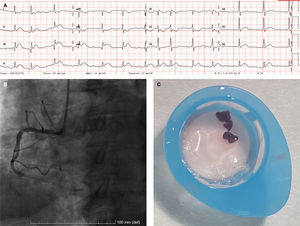
    En el síndrome coronario agudo la rotura de placa y el trombo provocan una oclusión total y nuestro objetivo será conseguir lo antes posible la reperfusión mediante intervención coronaria percutánea o fibrinólisis.

  • •

    Las mujeres, las personas mayores y las personas con diabetes pueden experimentar síntomas inespecíficos o equivalentes de isquemia.

  • •

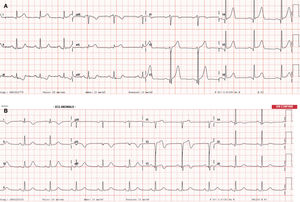
    Cuando el ECG inicial no es diagnóstico deben realizarse ECG secuenciales y utilizar derivaciones electrocardiográficas adicionales de V7 a V9 V3R y V4R.

  • •

    La atención prehospitalaria de los pacientes con SCACEST influye directamente en la probabilidad de supervivencia; la teleconsulta ayuda en la toma de decisiones y debe utilizarse para coordinar la terapia prehospitalaria.

  • •

    Cuando el paciente se presenta en un centro que no dispone de alerta hemodinámica se debe realizar el traslado a un centro que tenga los medios si el tiempo previsto hasta la realización de la angioplastia es menor a 120 minutos.

  • •

    Hay que administrar ácido acetilsalicílico salvo contraindicación desde el primer contacto médico con el paciente con sospecha de síndrome coronario agudo.

  • •

    Existen diferencias, desigualdades y sesgos de género en el manejo del SCA que es preciso reducir mejorando la formación de nuestros profesionales, la sensibilización de las mujeres y actuando de manera proactiva para detectar y acabar con estas diferencias.

Palabras clave
Síndrome coronario agudo
Angina inestable
Intervencionismo coronario percutáneo

Identifíquese

¿Aún no es suscriptor de la revista?
Comprar el acceso al artículo

Comprando el artículo el pdf del mismo podrá ser descargado

Teléfono para incidencias

De lunes a viernes de 9h a 18h (GMT+1) excepto los meses de julio y agosto que será de 9 a 15h
Llamadas desde España 932 415 960
Llamadas desde fuera de España +34 932 415 960
Bibliografía
[1]
M. Gulati, P.D. Levy, D. Mukherjee, E. Amsterdam, D.L. Bhatt, K.K. Birtcher, et al.
2021 AHA/ACC/ASE/CHEST/SAEM/SCCT/SCMR guideline for the evaluation and diagnosis of chest pain: a report of the American College of Cardiology/American Heart Association Joint Committee on Clinical Practice Guidelines.
Circulation., (2021), 144 pp. e368-e454
[2]
GBD 2019 Diseases and Injuries Collaborators.
Global burden of 369 diseases and injuries in 204 countries and territories, 1990-2019: a systematic analysis for the Global Burden of Disease Study 2019.
Lancet, (2020), 17;396 pp. 1204-1222
[3]
Instituto Nacional de Estadística. Estadística de defunciones según la causa de muerte [Internet]. 2020. Disponible en: https://www.ine.es/dynt3/inebase/es/index.htm?padre=8280∩sel=8281.
[4]
J. Darbà, A. Marsà.
Burden of ischemic heart disease in Spain: incidence, hospital mortality and costs of hospital care.
Expert Rev Pharmacoecon Outcomes Res., (2022), 22 pp. 1147-1152
[5]
M.A. Albert, R.J. Glynn, J. Buring, S. Paul, M. Ridker.
Impact of Traditional and Novel Risk Factors on the Relationship Between Socioeconomic Status and Incident Cardiovascular Events.
(2006),
[6]
S. Rajagopalan, S.G. Al-Kindi, R.D. Brook.
Air Pollution and Cardiovascular Disease.
JACC [Internet]., (2018), 72 pp. 2054-2070
[7]
R. Menezes Fernandes, T. Mota, H. Costa, J. Bispo, P. Azevedo, D. Bento, et al.
Portuguese Registry of Acute Coronary Syndromes (ProACS) investigators. Premature acute coronary syndrome: understanding the early onset.
Coron Artery Dis., (2022), 33 pp. 456-464
[8]
Y. Sandoval, S.W. Smith, A. Sexter, I.L. Gunsolus, K. Schulz, F.S. Apple.
Clinical Features and Outcomes of Emergency Department Patients With High-Sensitivity Cardiac Troponin I Concentrations Within SexSpecific Reference Intervals.
Circulation., (2019), 139 pp. 1753-1755
[9]
Ò. Miró, G. Martínez-Nadal, A. García, B. López-Barbeito, M. Carbó, A. Placer, et al.
Factors associated with erroneous emergency department noncardiac chest pain classifications in men and women.
Emergencias., (2022), 34 pp. 268-274
[10]
Y. Zhu, B. Lingala, M. Baiocchi, J.J. Tao, V. Toro Arana, J.W. Khoo, et al.
Type A Aortic Dissection-Experience Over 5 Decades: JACC Historical Breakthroughs in Perspective.
J Am Coll Cardiol., (2020), 76 pp. 170313
[11]
E.M. Tomkiewicz, J.A. Kline.
Concise Review of the Clinical Approach to the Exclusion and Diagnosis of Pulmonary Embolism in 2020.
J Emerg Nurs., (2020), 46 pp. 527-538
[12]
J.P. Collet, H. Thiele, E. Barbato, O. Barthélémy, J. Bauersachs, D.L. Bhatt, et al.
2020 ESC Guidelines for the management of acute coronary syndromes in patients presenting without persistent ST-segment elevation.
Eur Heart J., (2021), 42 pp. 1289-1367
[13]
J.A. Barrabés, A. Bardají, J. Jiménez-Candil, V. Bodí, R. Freixa, R. Vázquez, et al.
Characteristics and Outcomes of Patients Hospitalized With Suspected Acute Coronary Syndrome in Whom the Diagnosis is not Confirmed.
Am J Cardiol., (2018), 122 pp. 1604-1609
[14]
K. Thygesen, J.S. Alpert, A.S. Jaffe, B.R. Chaitman, J.J. Bax, D.A. Morrow, et al.
Executive Group on behalf of the Joint European Society of Cardiology (ESC)/American College of Cardiology (ACC)/American Heart Association (AHA)/World Heart Federation (WHF) Task Force for the Universal Definition of Myocardial Infarction. Fourth Universal Definition of Myocardial Infarction (2018).
J Am Coll Cardiol., (2018), 72 pp. 2231-2264
[15]
T. Nestelberger, L. Cullen, B. Lindahl, T. Reichlin, J.H. Greenslade, E. Giannitsis, et al.
Diagnosis of acute myocardial infarction in the presence of left bundle branch block.
Heart., (2019), 105 pp. 1559-1567
[16]
B. Ibanez, S. James, S. Agewall, M.J. Antunes, C. Bucciarelli-Ducci, H. Bueno, et al.
2017 ESC Guidelines for the management of acute myocardial infarction in patients presenting with ST-segment elevation: The Task Force for the management of acute myocardial infarction in patients presenting with ST-segment elevation of the European Society of Cardiology (ESC).
Eur Heart J., (2018), 39 pp. 119-177
[17]
Q. Cai, N. Mehta, E.B. Sgarbossa, S.L. Pinski, G.S. Wagner, R.M. Califf, et al.
The left bundle-branch block puzzle in the 2013 ST-elevation myocardial infarction guideline: from falsely declaring emergency to denying reperfusion in a high-risk population. Are the Sgarbossa Criteria ready for prime time?.
Am Heart J., (2013), 166 pp. 409-413
[18]
J.A. Prieto-Solís, N. Benito, R. Martín-Durán.
Diagnóstico electrocardiográfico de la obstrucción del tronco coronario izquierdo mediante el análisis vectorial del segmento ST y el complejo QRS.
Rev Esp Cardiol., (2008), 61 pp. 137-145
[19]
J.T. Neumann, N.A. Sörensen, N. Rübsamen, F. Ojeda, S. Schäfer, T. Keller, et al.
Right bundle branch block in patients with suspected myocardial infarction.
Eur Heart J Acute Cardiovasc Care., (2019), 8 pp. 161-166
[20]
G. Mnatzaganian, J.E. Hiller, G. Braitberg, M. Kingsley, M. Putland, M. Bish, et al.
Sex disparities in the assessment and outcomes of chest pain presentations in emergency departments.
[21]
G.N. Levine, E.R. Bates, J.C. Blankenship, S.R. Bailey, J.A. Bittl, B. Cercek, et al.
2015 ACC/AHA/SCAI focused update on primary percutaneous coronary intervention for patients with st-elevation myocardial infarction: an update of the 2011 ACCF/AHA/SCAI guideline for percutaneous coronary intervention and the 2013 ACCF/AHA guideline for the management of st-elevation myocardial infarction.
J Am Coll Cardiol., (2016), 67 pp. 1235-1250
[22]
F.-J. Neumann, M. Sousa-Uva, A. Ahlsson, F. Alfonso, A.P. Banning, U. Benedetto, et al.
2018 ESC/EACTS Guidelines on myocardial revascularization.
Eur Heart J., (2019), 40 pp. 87-165
[23]
R. Fazel, T.I. Joseph, M.A. Sankardas, D.S. Pinto, R.W. Yeh, D.J. Kumbhani, et al.
Comparison of Reperfusion Strategies for ST-Segment-Elevation Myocardial Infarction: A Multivariate Network Meta-analysis.
J Am Heart Assoc., (2020), 9 pp. e015186
[24]
Consejería de Salud de Murcia. Disponible en https://www.murciasalud.es/recursos/ficheros/436580-CODIGO.IAM_15_NOV.2018.pdf.
[25]
C. Llanos Val Jiménez, M. Campo Giménez, E.M. García Atienza.
Actualización del Código de Reperfusión Coronaria de Castilla-La Mancha (CORECAM). Medidas de actuación en Atención Primaria.
Rev Clin Med Fam [Internet], (2019), 12 pp. 75-81
[26]
J. Kubica, P. Adamski, J.R. Ładny, J. Kaźmierczak, T. Fabiszak, K.J. Filipiak, et al.
Pre-hospital treatment of patients with acute coronary syndrome: Recommendations for medical emergency teams. Expert position update 2022.
Cardiol J., (2022), 29 pp. 540-552
[27]
R. Batchelor, D.H. Liu, J. Bloom, S. Noaman, W. Chan.
Association of periprocedural intravenous morphine use on clinical outcomes in ST-elevation myocardial infarction (STEMI) treated by primary percutaneous coronary intervention: Systematic review and meta-analysis.
Catheter Cardiovasc Interv., (2020), 96 pp. 76-88
[28]
J. Kubica, A. Kubica, B. Jilma, P. Adamski, E.L. Hobl, E.P. Navarese, et al.
Impact of morphine on antiplatelet effects of oral P2Y12 receptor inhibitors.
Int J Cardiol., (2016), 215 pp. 201-208
[29]
M. Valgimigli, H. Bueno, R.A. Byrne, J.P. Collet, F. Costa, A. Jeppsson, et al.
2017 ESC focused update on dual antiplatelet therapy in coronary artery disease developed in collaboration with EACTS: The Task Force for dual antiplatelet therapy in coronary artery disease of the European Society of Cardiology (ESC) and of the European Association for Cardio-Thoracic Surgery (EACTS).
Eur Heart J., (2018), 39 pp. 213-260
[30]
I.Z. Restan, A.Y. Sanchez, O.T. Steiro, P. Lopez-Ayala, H.L. Tjora, J. Langørgen, et al.
Adding stress biomarkers to high-sensitivity cardiac troponin for rapid non-ST-elevation myocardial infarction rule-out protocols.
Eur Heart J Acute Cardiovasc Care., (2022), 11 pp. 201-212
[31]
M. Will, T.W. Weiss.
Rise and fall of troponin in the emergency department: do we overlook an important group at risk?.
Intern Emerg Med., (2022), 17 pp. 635-637
[32]
A. Zümrütdal, O. Bakinen, H. Uçan, H.V. Atalay, H. Bodur.
Relationship between uremic myopathy and false-positive cardiac troponin T test.
Nephron., (2000), 86 pp. 522-523
[33]
A.S. Shah, A. Anand, Y. Sandoval, K.K. Lee, S.W. Smith, P.D. Adamson, et al.
High-sensitivity cardiac troponin I at presentation in patients with suspected acute coronary syndrome: a cohort study.
Lancet., (2015), 386 pp. 2481-2488
[34]
Y. Tsutsumi, Y. Tsujimoto, S. Takahashi, A. Tsuchiya, S. Fukuma, Y. Yamamoto, et al.
Accuracy of aortic dissection detection risk score alone or with D-dimer: A systematic review and meta-analysis.
Eur Heart J Acute Cardiovasc Care., (2020), 9 pp. S32-S39
[35]
P.A. Kavsak, J.T. Neumann, L. Cullen, M. Than, C. Shortt, J.H. Greenslade, et al.
Clinical chemistry score versus high-sensitivity cardiac troponin I and T tests alone to identify patients at low or high risk for myocardial infarction or death at presentation to the emergency department.
CMAJ., (2018), 190 pp. E974-E984
[36]
F.J. García Almagro, J.R. Gimeno, M. Villegas, L. Muñoz, E. Sánchez, F. Teruel, et al.
Aplicación de una puntuación de riesgo coronario (TIMI Risk Score) en una población no seleccionada de pacientes que consultan por dolor torácico en un servicio de urgencias.
Rev Esp Cardiol., (2005), 58 pp. 775-781
[37]
C.A. Tomaszewski, D. Nestler, K.H. Shah, A. Sudhir, M.D. Brown, S.J. Wolf, et al.
Clinical policy: Critical Issues in the Evaluation and Management of Emergency Department Patients with Suspected non-ST-Elevation Acute Coronary Syndromes.
Ann Emerg Med., (2018), 72 pp. e65-e106
[38]
F. D’Ascenzo, G. Biondi-Zoccai, C. Moretti, M. Bollati, P. Omedé, F. Sciuto, et al.
TIMI, GRACE and alternative risk scores in acute coronary syndromes: a meta-analysis of 40 derivation studies on 216,552 patients and of 42 validation studies on 31,625 patients.
Contemp Clin Trials., (2012), 33 pp. 507-514
[39]
D.G. Mark, J. Huang, M.V. Kene, D.R. Sax, D.M. Cotton, J.S. Lin, et al.
Kaiser Permanente CREST Network Investigators. Prospective Validation and Comparative Analysis of Coronary Risk Stratification Strategies Among Emergency Department Patients With Chest Pain.
J Am Heart Assoc., (2021), 10 pp. e020082
[40]
M. Roffi, C. Patrono, J.P. Collet, C. Mueller, M. Valgimigli, F. Andreotti, et al.
Management of Acute Coronary Syndromes in Patients Presenting without Persistent ST-Segment Elevation of the European Society of Cardiology. 2015 ESC Guidelines for the management of acute coronary syndromes in patients presenting without persistent ST-segment elevation: Task Force for the Management of Acute Coronary Syndromes in Patients Presenting without Persistent ST-Segment Elevation of the European Society of Cardiology (ESC).
Eur Heart J., (2016), 37 pp. 267-315
[41]
K.F. Kofoed, H. Kelbæk, P.R. Hansen, C. Torp-Pedersen, D. Høfsten, L. Kløvgaard, et al.
Early Versus Standard Care Invasive Examination and Treatment of Patients With Non-ST-Segment Elevation Acute Coronary Syndrome.
Circulation., (2018), 138 pp. 2741-2750
[42]
S. Subherwal, R.G. Bach, A.Y. Chen, B.F. Gage, S.V. Rao, L.K. Newby, et al.
Baseline risk of major bleeding in non-ST-segment-elevation myocardial infarction: the CRUSADE (Can Rapid risk stratification of Unstable angina patients Suppress ADverse outcomes with Early implementation of the ACC/AHA Guidelines) Bleeding Score.
Circulation., (2009), 119 pp. 1873-1882
[43]
L. Wallentin, D. Lindholm, A. Siegbahn, L. Wernroth, R.C. Becker, C.P. Cannon, et al.
PLATO Study Group. Biomarkers in relation to the effects of ticagrelor in comparison with clopidogrel in non-ST-elevation acute coronary syndrome patients managed with or without in-hospital revascularization: a substudy from the Prospective Randomized Platelet Inhibition and Patient Outcomes (PLATO) trial.
Circulation, (2014), 129 pp. 293-303
[44]
W. Wang, Q. Huang, D. Pan, W. Zheng, S. Zheng.
The optimal duration of triple antithrombotic therapy in patients with atrial fibrillation and acute coronary syndrome or undergoing percutaneous coronary intervention: A network meta-analysis of randomized.
Int J Cardiol., (2022), 357 pp. 33-38
[45]
I. Mateo-Rodríguez, A. Danet, J. Bolívar-Muñoz, F. Rosell-Ortriz, L. Garcia-Mochón, A. Daponte-Codina.
Gender differences, inequalities and biases in the management of Acute Coronary Syndrome.
J Healthc Qual Res., (2022), 37 pp. 169-181
[46]
A. Ayesta, C. Bonanad, P. Díez-Villanueva, S. García-Blas, A. Ariza-Solé, M. Martínez-Sellés.
Ethical considerations in elderly patients with acute coronary syndrome.
Rev Cardiovasc Med., (2022), 23 pp. 55