

Vol. 30. Núm. 1.
Páginas 11-17 (Enero 2023)

Actualizando la práctica asistencial
Fiebre sin foco

Francisco Buitrago RamírezaFátima Mora MonagobAlba Palmerín DonosocJosé Antonio Morales GabardinodManuel Tejero Mase
Doi : https://10.1016/j.fmc.2022.03.013
Opciones
Puntos para una lectura rápida

  • •

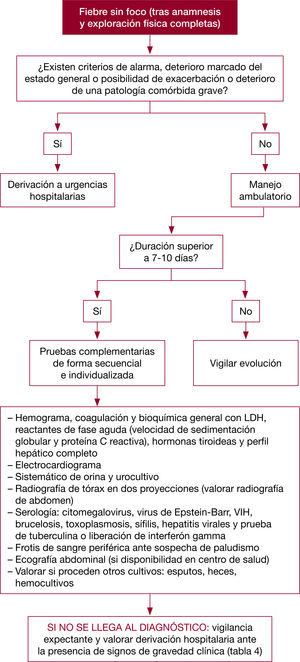
    El término “fiebre sin foco” hace referencia a cualquier enfermedad febril aguda de ≤ 1 semana de aparición en la que no ha sido posible esclarecer su etiología, tras una historia clínica y un examen físico completos.

  • •

    La mayoría de los cuadros febriles sin foco aparente se deben a enfermedades comunes con manifestaciones o presentaciones atípicas, más que a la presencia de una enfermedad rara.

  • •

    Las causas identificables de los síndromes febriles varían en función de la edad de los pacientes, el ámbito geográfico analizado, la exposición potencial a agentes infecciosos, la susceptibilidad del paciente concreto a las infecciones y la disponibilidad y accesibilidad a diferentes técnicas diagnósticas.

  • •

    En población general los grandes grupos de enfermedades que explican la mayoría de los cuadros febriles son las infecciones, las enfermedades inflamatorias no infecciosas y las neoplasias.

  • •

    Los medicamentos son también una causa potencial de fiebre, y por tanto debe considerarse la interrupción temporal de cualquier medicamento nuevo sospechoso.

  • •

    La mitad de los pacientes con cuadros febriles pueden quedar finalmente sin un diagnóstico etiológico, aconsejándose en ellos una vigilancia expectante, dado que la mayoría suelen tener un buen pronóstico e incluso una remisión espontánea.

Palabras clave
Fiebre sin foco
Síndrome febril
Fiebre de origen desconocido
Infecciones
Tumores

Identifíquese

¿Aún no es suscriptor de la revista?
Comprar el acceso al artículo

Comprando el artículo el pdf del mismo podrá ser descargado

Teléfono para incidencias

De lunes a viernes de 9h a 18h (GMT+1) excepto los meses de julio y agosto que será de 9 a 15h
Llamadas desde España 932 415 960
Llamadas desde fuera de España +34 932 415 960
Bibliografía
[1]
M. Gurven, T.S. Kraft, S. Alami, J. Copajira, E. Cortez, D. Cummings, et al.
Rapidly declining body temperature in a tropical human population.
Sci Adv., (2020), 6 pp. eabc6599
[2]
C. Llor, C. Bayona.
Paciente febril sin foco.
FMC., (2012), 19 pp. 529-533
[3]
Palazzi DL. Fever of unknown origin in children: Etiology. [consultado 12 Feb 2022]. Disponible en: https://www-uptodate-com.
[4]
C.P. Bleeker-Rovers, F.J. Vos, A.H. Mudde, A.S.M. Dofferhoff, L.F. de Geus-Oei, A.J. Rijnders, et al.
A prospective multi-centre study of the value of FDG-PET as part of a structured diagnostic protocol in patients with fever of unknown origin.
Eur J Nucl Med Mol Imaging., (2007), 34 pp. 694-703
[5]
E.M. De Kleijn, J.P. Vandenbroucke, J.W. van der Meer.
Fever of unknown origin (FUO). I. a prospective multicenter study of 167 patients with FUO, using fixed epidemiologic entry criteria.
Medicine (Baltimore)., (1997), 76 pp. 392-400
[6]
T. Zenone.
Fever of unknown origin in adults: evaluation of 144 cases in a non-university hospital.
Scand J Infect Dis., (2006), 38 pp. 632-638
[7]
R.G. Petersdorf, P.B. Beeson.
Fever of unexplained origin: report on 100 cases.
Medicine (Baltimore)., (1961), 40 pp. 1-30
[8]
G. Haidar, N. Singh.
Fever of Unknown Origin.
N Engl J Med., (2022), 386 pp. 463-477
[9]
D.T. Durack, A.C. Street.
Fever of unknown origin: reexamined and redefined.
Curr Clin Top Infect Dis., (1991), 11 pp. 35-51
[10]
W.F. Wright, C.M. Mulders-Manders, P.G. Auwaerter, C.P. Bleeker-Rovers.
Fever of unknown origin (FUO): a call for new research standards and updated clinical management.
Am J Med., (2021), 135 pp. 173-178
[11]
W.F. Wright, P.G. Auwaerter.
Fever and Fever of Unknown Origin: Review, Recent Advances, and Lingering Dogma.
Open Forum Infectious Diseases, (2020), 7 pp. ofaa132
[12]
Bor DH. Approach to the adult with fever of unknown origin. [consultado 12 Feb 2022]. Disponible en: https://www-uptodate-com.
[13]
O. Mourad, V. Palda, A.S. Detsky.
A comprehensive evidence-based approach to fever of unknown origin.
Arch Intern Med., (2003), 163 pp. 545-551
[14]
G.M. Varghese, P. Trowbridge, T. Doherty.
Investigating and managing pyrexia of unknown origin in adults.
BMJ, (2010), 341 pp. C5470
[15]
J.V. Hirschmann.
Fever of unknown origin in adults.
Clin Infect Dis., (1997), 24 pp. 291-300
[16]
J. Ruiz Contreras, I. Durán Lorenzo.
Fiebre de origen desconocido en niños.
Pediatr Integral., (2018), 22 pp. 229-235
[17]
A. Chow, J.L. Robinson.
Fever of unknown origin in children: A systematic review.
World J Pediatr., (2011), 7 pp. 5-10
[18]
P.A. Pizzo, F.H. Lovejoy Jr., D.H. Smith.
Prolonged fever in children: review of 100 cases.
Pediatrics., (1975), 55 pp. 468-473
[19]
D.C. Knockaert, L.J. Vanneste, H.J. Bobbaers.
Fever of unknown origin in elderly patients.
J Am Geriatr Soc., (1993), 41 pp. 1187-1192
[20]
C. Fernández, N.J. Beeching.
Pyrexia of unknown origin.
Clin Med (Lond)., (2018), 18 pp. 170-174
[21]
G.B. Gaeta, F.M. Fusco, S. Nardiello.
Fever of unknown origin: a systematic review of the literature for 1995-2004.
Nucl Med Commun., (2006), 27 pp. 205-211
[22]
F.M. Fusco, R. Pisapia, S. Nardiello, S.D. Cicala, G.B. Gaeta, G. Brancaccio.
Fever of unknown origin (FUO): which are the factors influencing the final diagnosis?. A 2005-2015 systematic review.
BMC Infect Dis., (2019), 19 pp. 653
[23]
Bor DB. Etiologies of fever of unknown origin in adults. [consultado 12 feb 2022]. Disponible en: https://www-uptodate-com.
[24]
R.A. Patel, J.C. Gallagher.
Drug fever.
Pharmacotherapy., (2010), 30 pp. 57-69
[25]
S. Pasic, A. Minic, P. Djuric, D. Micic, M. Kuzmanovic, L. Sarjanovic, et al.
Fever of unknown origin in 185 paediatric patients: a single-centre experience.
Acta Paediatr., (2006), 95 pp. 463-466
[26]
C.Y. Cho, C.C. Lai, M.L. Lee, C.L. Hsu, C.J. Chen, L.Y. Chang, et al.
Clinical analysis of fever of unknown origin in children: A10 year experience in a northern Taiwan medical center.
J Microbiol Immunol Infect., (2017), 50 pp. 40-45
[27]
J.W. Antoon, D.C. Peritz, M.R. Parsons, A.S. Skinner, J.A. Lohr.
Etiology and Resource Use of Fever of Unknown Origin in Hospitalized Children.
Hosp Pediatr., (2018), 8 pp. 135-140
[28]
L.R. Zacharski, R.A. Kyle.
Significance of extreme elevation of erythrocyte sedimentation rate.
JAMA., (1967), 202 pp. 264
[29]
F. Buitrago, A. Pagador, C. Gato.
Cuándo solicitar la velocidad de sedimentación globular y cómo interpretarla cuando está elevada.
[30]
B. Fautrel, G. Le Moel, B. Saint-Marcoux, P. Taupin, S. Vignes, S. Rozenberg, et al.
Diagnostic value of ferritin and glycosylated ferritin in adult onset Still's disease.
J Rheumatol., (2001), 28 pp. 322-329
[31]
D.C. Knockaert, K.S. Dujardin, H.J. Bobbaers.
Long-term follow-up of patients with undiagnosed fever of unknown origin.
Arch Intern Med., (1996), 156 pp. 618-620