

Vol. 27. Núm. 9.
Páginas 476-479 (Noviembre 2020)

¿Qué debería saber el médico de familia sobre...?
Pacientes no iniciadores de tratamientos

Cristina Carbonell-DuacastellaaM.ª Montserrat Gil-GirbaubM.ª Teresa Peñarrubia-MaríacMaria Rubio-ValeraaIgnacio Aznar-Loua
Doi : https://10.1016/j.fmc.2019.12.010
Opciones
Puntos para una lectura rápida

  • •

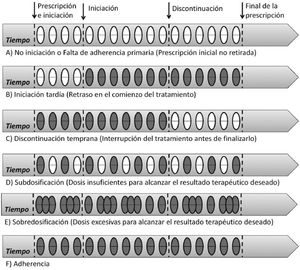
    La no iniciación es un comportamiento de adherencia farmacoterapéutica recientemente estudiado.

  • •

    Uno de cada seis nuevos tratamientos prescritos en atención primaria no se retiran de la farmacia.

  • •

    La no iniciación es más frecuente en tratamientos agudos que en crónicos.

  • •

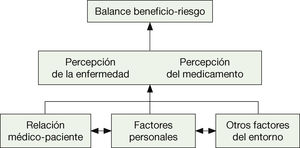
    Ante una nueva prescripción, los pacientes realizan un balance beneficio-riesgo influido por factores intrapersonales, interpersonales y del contexto.

  • •

    La no iniciación farmacológica genera peores resultados en salud y aumenta el gasto sanitario.

  • •

    Actualmente, se están desarrollando intervenciones para reducir la no iniciación en el contexto de atención primaria.

Palabras clave
Atención primaria
Adherencia farmacológica
Prevalencia
Uso de servicios sanitarios
Investigación cualitativa

Identifíquese

¿Aún no es suscriptor de la revista?
Comprar el acceso al artículo

Comprando el artículo el pdf del mismo podrá ser descargado

Teléfono para incidencias

De lunes a viernes de 9h a 18h (GMT+1) excepto los meses de julio y agosto que será de 9 a 15h
Llamadas desde España 932 415 960
Llamadas desde fuera de España +34 932 415 960
Bibliografía
[1]
B. Vrijens, S. De Geest, D.A. Hughes, K. Przemyslaw, J. Demonceau, T. Ruppar, et al.
A new taxonomy for describing and defining adherence to medications.
Br J Clin Pharmacol., (2012), 73 pp. 691-705
[2]
World Health Organization.
Adherence to long-term therapies: Evidence for action.
(2003),
[3]
E. Costa, A. Giardini, M. Savin, E. Menditto, E. Lehane, O. Laosa, et al.
Interventional tools to improve medication adherence: review of literature.
Patient Prefer Adherence, (2015), 9 pp. 1303-1314
[4]
J.E. Zeber, E. Manias, A.F. Williams, D. Hutchins, W.A. Udezi, C.S. Roberts, et al.
A systematic literature review of psychosocial and behavioral factors associated with initial medication adherence: A report of the ISPOR medication adherence & persistence special interest group.
Value Health., (2013), 16 pp. 891-900
[5]
I. Aznar-Lou.
El problema de la no iniciación del tratamiento farmacológico: evaluación con métodos quantitativos.
Universitat de Barcelona, (2017),
[6]
E. Wiecek, F.S. Tonin, A. Torres-Robles, S.I. Benrimoj, F. Fernandez-Llimos, V. Garcia-Cardenas.
Temporal effectiveness of interventions to improve medication adherence: A network meta-analysis.
PLoS One., (2019), 14 pp. e0213432
[7]
I. Aznar-Lou, A. Fernández, M. Gil-Girbau, M. Fajó-Pascual, P. Moreno-Peral, M.T. Peñarrubia-María, et al.
Initial medication non-adherence: prevalence and predictive factors in a cohort of 1.6 million primary care patients.
Br J Clin Pharmacol., (2017), 83 pp. 1328-1340
[8]
F. Ax, A. Ekedahl.
Electronically transmitted prescriptions not picked up at pharmacies in Sweden.
Res Soc Adm Pharm., (2010), 6 pp. 70-77
[9]
A. Pottegård, R. Christensen dePont, A. Houji, C.B. Christiansen, M.S. Paulsen, J.L. Thomsen, et al.
Primary non-adherence in general practice: a Danish register study.
Eur J Clin Pharmacol., (2014), 70 pp. 757-763
[10]
M.A. Fischer, N.K. Choudhry, G. Brill, J. Avorn, S. Schneeweiss, D. Hutchins, et al.
Trouble getting started: Predictors of primary medication nonadherence.
Am J Med., (2011), 124
[11]
M.H.H. Cheen, Y.Z. Tan, L.F. Oh, H.L. Wee, J. Thumboo.
Prevalence of and factors associated with primary medication non-adherence in chronic disease: A systematic review and meta-analysis.
Int J Clin Pract., (2019), 73 pp. 1-18
[12]
M. Lemstra, C. Nwankwo, Y. Bird, J. Moraros.
Primary nonadherence to chronic disease medications: A meta-analysis.
Patient Prefer Adherence., (2018), 12 pp. 721-731
[13]
J.M. Polinski, A.S. Kesselheim, J.P. Frolkis, P. Wescott, C. Allen-Coleman, M.A. Fischer.
A matter of trust: Patient barriers to primary medication adherence.
Health Educ Res., (2014), 29 pp. 755-763
[14]
P. Srimongkon, P. Aslani, T.F. Chen.
Consumer-related factors influencing antidepressant adherence in unipolar depression: A qualitative study.
Patient Prefer Adherence, (2018), 12 pp. 1863-1873
[15]
K.M.A. Swart, M. Van Vilsteren, W. Van Hout, E. Draak, B.C. Van Der Zwaard, H.E. Van Der Horst, et al.
Factors related to intentional non-initiation of bisphosphonate treatment in patients with a high fracture risk in primary care: A qualitative study.
[16]
M. Gil-Girbau, I. Aznar-Lou, M.T. Peñarrubia-María, P. Moreno-Peral, A. Fernandez, Bellón JÁ, et al.
Reasons for medication non-initiation: a qualitative exploration of the patients’ perspective (Under Review).
Res Soc Adm Pharm., (2019),
[17]
M.T. Peñarrubia-María, M. Gil-Girbau, C. Carbonell-Duacastella, I. Aznar-Lou, M. Gallardo-Gonzalez, C. del, J.M. Mendive, et al.
Reasons for initial medication non-adherence from a health professionals’ perspective: a qualitative exploration. Submitted.
(2020),
[18]
A.P. Rathbone, A. Todd, K. Jamie, M. Bonam, L. Banks, A.K. Husband.
A systematic review and thematic synthesis of patients’ experience of medicines adherence.
Res Social Adm Pharm., (2017), 13 pp. 403-439
[19]
N.R. Shah, A.G. Hirsch, C. Zacker, S. Taylor, G.C. Wood, W.F. Stewart.
Factors associated with first-fill adherence rates for diabetic medications: A cohort study.
J Gen Intern Med., (2009), 24 pp. 233-237
[20]
N.R. Shah, A.G. Hirsch, C. Zacker, G.C. Wood, A. Schoenthaler, G. Ogedegbe, et al.
Predictors of first-fill adherence for patients with hypertension.
Am J Hypertens., (2009), 22 pp. 392-396
[21]
C.A. Jackevicius, P. Li, J.V. Tu.
Prevalence, predictors, and outcomes of primary nonadherence after acute myocardial infarction.
Circulation., (2008), 117 pp. 1028-1036
[22]
I. Aznar-Lou, A. Fernández, M. Gil-Girbau, R. Sabés-Figuera, M. Fajó-Pascual, M.T. Peñarrubia-María, et al.
Impact of initial medication non-adherence on use of healthcare services and sick leave: a longitudinal study in a large primary care cohort in Spain.
Br J Gen Pract., (2017), 67 pp. e614-e622